One mom’s messy, mindful journey to heal her relationship with food—while juggling chaos, kids, and cravings.

My house is rarely quiet, my to-do list is never done, and most days, I’m just trying to choose compassion over chaos (and maybe not eat my feelings… again).

Sound familiar? Then you might be in the right place.

This blog is for the moms who feel like they’re drowning in snacks, schedules, and self-doubt. The ones who binge on goldfish and guilt in the pantry after bedtime, who lose themselves in motherhood and then try to find themselves in a fresh start every Monday. (Same, girl. Same.)

I created Chaos & Carrots to document what it really looks like to lose weight — not just on the scale, but the mental and emotional weight we carry as women, moms, and humans with a long history of food shame. This is my honest attempt to make peace with food, show up for myself, and find mindful moments in the mess.


So what can you expect here?

If you’re looking for perfection, this isn’t it. But if you’re looking for progress, self-trust, and maybe a reminder that you’re not alone — welcome. I’m so glad you’re here. 💛

Let’s figure this chaos out together — one carrot at a time.

My Latest Posts

  • Fat Is Not My Identity

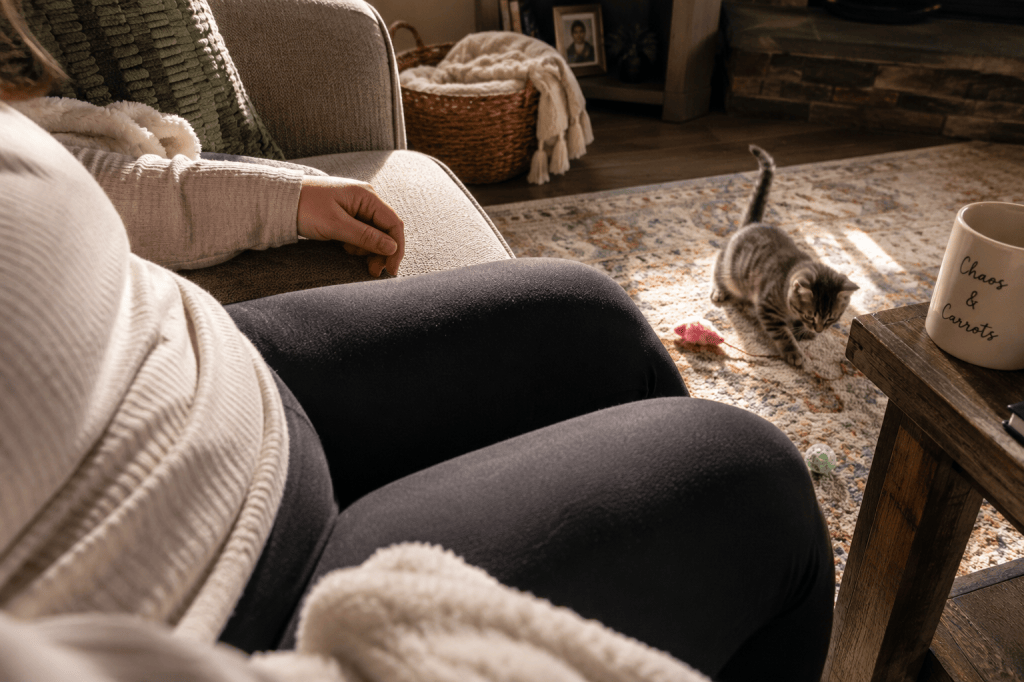
    I was holding one of our new kittens the other day.

    I sat down with her, hoping she’d finally just curl up on me for a minute.

    She immediately took off.

    “She never just wants to lay on me when I sit down,” I said.

    And my son, with the completely unfiltered honesty only a kid can deliver, said:

    “Well, maybe it’s because you’re kinda fat.”

    Cool.

    Cool cool cool.

    There are certain things your child can say that you know, logically, were not designed to emotionally destroy you.

    And then there are the things they say that somehow locate your deepest insecurity, walk directly up to it, and punch it in the face.

    This was the second kind.

    Because my first thought wasn’t:

    He’s a kid. He doesn’t understand what that word means to me.

    It wasn’t:

    The kitten is a kitten and probably just wants to run around.

    It wasn’t even:

    Ouch.

    It was:

    Yeah. I am just a fatty.

    And then:

    Why would she want to sit on my fat lap?

    And then, almost immediately:

    Why even bother trying?

    And THAT is the part that gets me.

    Not that my son called me “kinda fat.”

    But how quickly my own brain took his comment and turned it into an identity.

    I wasn’t a woman who has been trying to take care of herself.

    I wasn’t a mom sitting on the couch holding her new kitten.

    I wasn’t a whole person with a body that happens to carry more fat than I want it to right now.

    I was just a fatty.

    And apparently the kitten agreed.
    Which, with approximately five seconds of emotional distance from the situation, is objectively ridiculous.

    She’s a kitten.

    I’m pretty sure she didn’t jump off my lap because she conducted a quick assessment of my body composition and decided the conditions were unacceptable.

    But shame isn’t particularly interested in logic.

    It heard one word.

    Fat.

    And it grabbed it.

    See?

    Other people see it too.

    This is what you are.

    Why even bother?

    That last one is the dangerous one for me.

    Because I’ve been here before.

    The place where not seeing the progress I want fast enough becomes a reason to stop trying altogether.

    Where one bad weigh-in becomes, What’s the point?

    Where one comment becomes, See? Nothing is changing.

    Where feeling bad about my body somehow becomes a reason to stop taking care of it.

    But this time, after the initial sting wore off, another thought came in.

    Fat is not my identity.

    I can have fat on my body.

    I can have more of it than I want.

    I can want to lose weight.

    I can actively be working toward changing my body.

    And none of that makes fat who I am.

    I don’t have to pretend my son’s comment didn’t hurt.

    It did.

    I don’t have to immediately counter it with, No! I’m beautiful! I love every inch of my body!

    That’s not even what this is about.

    This is about refusing to take something about my body and turn it into a definition of myself.

    But the more I thought about it, the more I realized I don’t just do this with my body.

    I’ve carried shame as an identity for so long that sometimes it feels like I’ve been doing it for lifetimes.

    It’s my go-to.

    It’s familiar.

    It’s addicting.

    And as uncomfortable as it is to admit, sometimes there’s even a kind of pleasure in it.

    Not because I actually want to feel terrible about myself.

    But because I know this place.

    I know how to suffer here.

    I know the thoughts.

    I’m worthless.

    Why even bother?

    I know exactly how the story goes.

    And recently, I felt myself going there again.

    Back into shame.

    Back into the familiar suffering.

    Back into those thoughts that wanted to tell me what something happening in my life meant about me and who I was.

    Except this time, I watched it happen.

    I watched that familiar suffering show up and try to claim me.

    And instead of completely disappearing into it, I could see what was happening.

    Oh.

    Here we go again.

    This is the story.

    I’ve been working really hard on recognizing these stories when they come up instead of automatically believing them.

    Not necessarily getting better at feeling them.

    But getting better at seeing them.

    I could still feel the heaviness there.

    Honestly, I can still feel it sometimes.

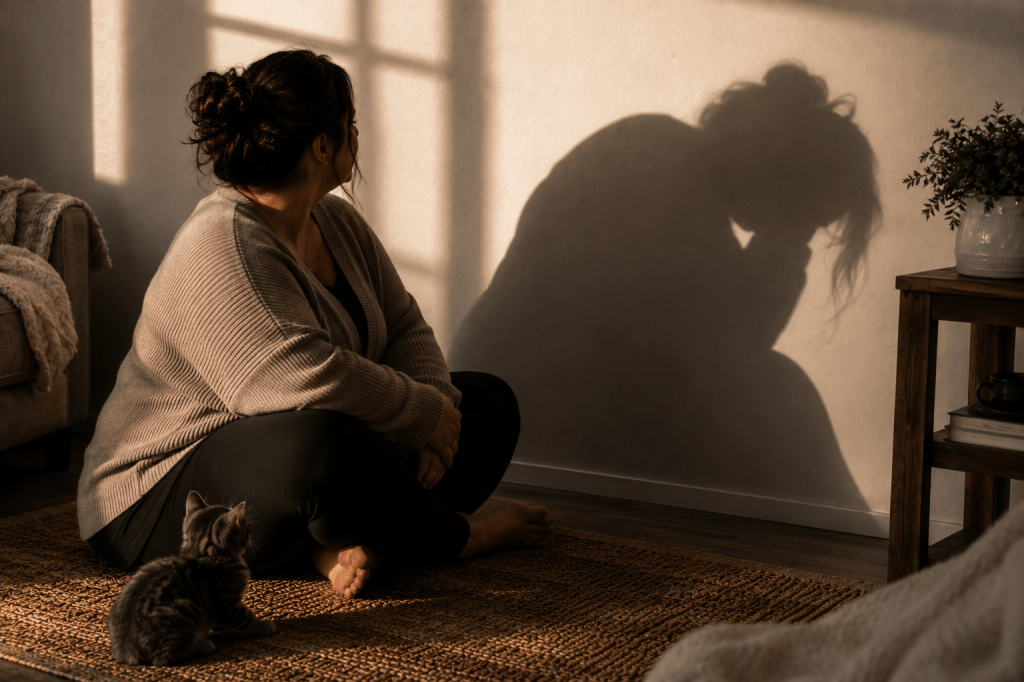
    Like a shadow hanging around, waiting for another opportunity to claim me.

    But it isn’t becoming me this time.

    And really, that’s exactly what had happened with the kitten.

    My son said one thing.

    And within seconds, shame had turned it into an entire story about who I was and why I should stop trying.

    Then I noticed something else.

    Lately, it had felt like one shameful thing after another.

    Boom.

    Boom.

    Boom.

    I was sitting there feeling all of it, listening to that familiar voice tell me:

    You’re worthless.

    Feeling that familiar shameful identity settle over me again.

    I know this version of myself.

    I’ve been her for a very long time.

    But this time, I could almost see the whole thing from the outside.

    And I thought:

    Oh my God.

    I’ve been looking at my life through a shame lens.

    Of course I’m seeing shame everywhere.

    I’m focused on the things that confirm it.

    Something happens, I interpret it through shame, I feel more shame, and then I notice the next thing that gives me another reason to feel ashamed.

    Maybe it wasn’t just one shameful thing after another.

    Maybe shame was the thing connecting them.

    And suddenly I had this little aha moment.

    If I can do that with shame…

    Can I do it with gratitude?

    If I’m constantly looking for things that confirm shame, what happens if I start looking for things to be grateful for instead?

    And if I take it even further—could focusing on gratitude actually attract more experiences into my life that give me something to be grateful for?

    I don’t know.

    But I know I’ve watched the opposite happen.

    I’ve watched shame become a lens.

    I’ve watched one experience seem to lead straight into another and another because that’s what I was looking for.

    That’s what I was expecting.

    That’s what felt familiar.

    And for a long time, I didn’t even realize I was doing it.

    I just thought that was my life.

    Maybe that’s what I’m most curious about now.

    What happens when I stop looking at my life through the emotion I’ve practiced for so long?

    What happens if shame isn’t the place I automatically come home to?

    What if I practice gratitude instead?

    I don’t know yet.

    But if I’ve spent this long practicing shame, I think I’d like to find out what happens when I practice something else.

    Because all of this started with one completely unfiltered comment from a kid who probably hasn’t thought about it again since.

    Meanwhile, I’m over here having an entire existential crisis because a kitten wouldn’t sit on my lap.

    Motherhood is magical.

    But I’m not giving up.

    Not because I’m suddenly unbothered by my body.

    I’m not.

    Not because words don’t hurt me anymore.

    They do.

    And not because shame doesn’t still know exactly where to find me.

    It does.

    I’m going to keep going because fat is not my identity.

    Shame isn’t my identity either.

    Shame can show up.

    I can feel it without letting it become me.

    But I don’t have to keep practicing it.

    And maybe now I get to decide what I practice instead.
  • What If You Don’t Know What Your Dream Life Looks Like?

    I’ve been trying to figure out what my dream life actually looks like.

    Which seems like it should be fun.

    Dream bigger! What do you want? What would you do if money didn’t matter? Imagine your perfect life!

    Except apparently I can turn even fantasizing about my own dream life into an existential crisis.

    Because one of the questions I’ve been sitting with lately is whether I would still choose the job I’ve worked at for almost 20 years if I didn’t need it anymore.

    And the answer is…

    I don’t know.

    Which is inconvenient.

    I feel like I’m supposed to know.

    If I’m trying to create this life where my blog grows, I write books, I keep coming up with ideas I’m excited about, and eventually I make really good money doing it… shouldn’t I be able to picture the grand finale?

    I quit my job.

    I walk away.

    I’m free.

    Except when I really ask myself if that’s what I want, I don’t actually know.

    Maybe I’d leave.

    Maybe I wouldn’t.

    I’ve been there for almost 20 years. It’s hard to separate what I would choose from something that has simply been part of my life for that long.

    And maybe that’s where I’ve been getting hung up. I’ve been trying to figure out the circumstances when what I actually care about is how I want my life to feel.

    I’ve said for a while now that what I really want is freedom and relief.

    Not necessarily a certain number in a bank account.

    Not a particular weight on the scale.

    Not even necessarily quitting my job.

    I want the feeling I think all of those things will give me.

    So I started thinking about Neville Goddard’s idea of imagining a tiny scene from the wish fulfilled. Something short. Maybe 20 seconds. A little clip I could play in my head over and over again.

    Basically: This is my life now.

    But what the hell was I supposed to put in the clip if I didn’t even know whether Future Me still had the same job?

    So I stopped trying to answer that question.

    I took work out of it completely.

    Instead, I imagined an ordinary Tuesday morning.

    Not a yacht.

    Not first class to Europe.

    Not me opening my banking app and discovering I had become a millionaire while I slept.

    Just Tuesday.

    It’s fall.

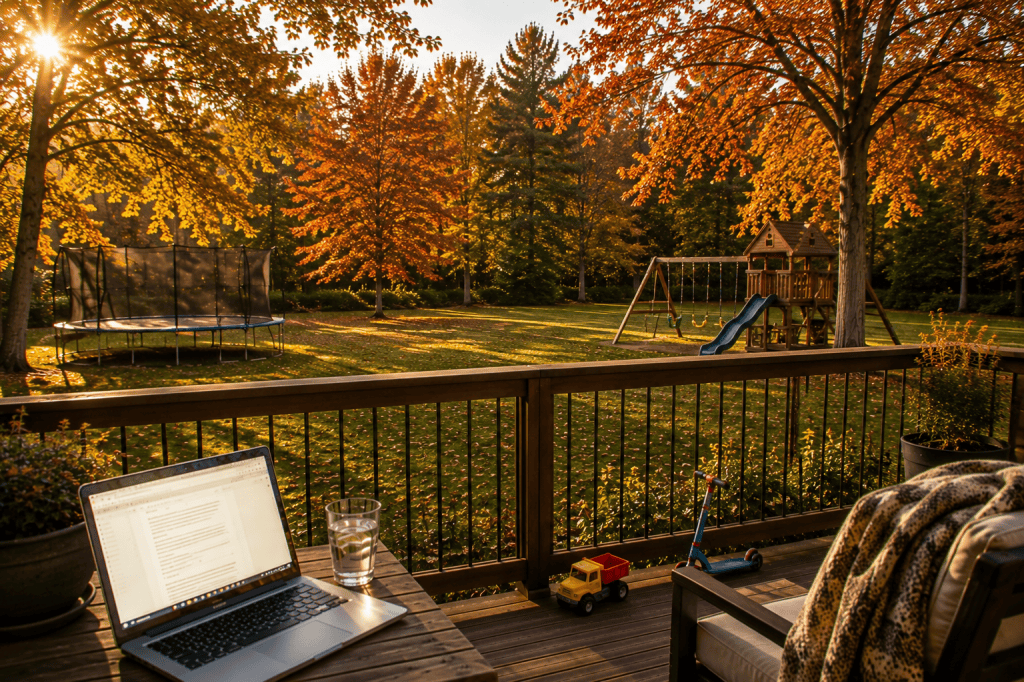
    The air outside is cool enough that I need a light jacket. I have a glass of salt water with me and my laptop open.

    And originally, I imagined myself sitting on a balcony.

    There was just one problem.

    I don’t have a balcony.

    And if I’m supposedly imagining my future life, why am I randomly giving myself a balcony?

    But then I thought… who cares?

    It’s my imaginary future.

    Apparently, I have a balcony now.

    So I went with it.

    I’m sitting outside. It’s quiet. My laptop is open and I have my glass of salt water.

    The house behind me. My family still inside.

    And me sitting there for a minute before the day really starts.

    Nothing particularly exciting is happening.

    That’s the weird thing.

    The dream wasn’t exciting.

    It was quiet.

    There was room for all of us here.

    I imagined looking around and thinking:

    I love our life.

    And something in me settled.

    I said, “I love that scene, that makes me feel safe.”

    Safe.

    Not successful.

    Not free, even.

    Safe.

    That word surprised me.

    Because I thought I was chasing freedom.

    And relief.

    And money.

    And a body I feel good in.

    And work that feels creative and meaningful.

    And a bigger house.

    Maybe I am.

    And now I wonder how many things I’ve spent my life chasing because somewhere underneath all of it, I thought once I got there I could finally unclench.

    I could finally stop worrying about what might happen.

    I could stop wondering if there would be enough.

    I could stop trying to solve the next problem before it even existed.

    I could just sit outside on a cool Tuesday morning with my stupid salt water and my laptop and look out from my apparently imaginary balcony.

    And feel safe.

    Maybe that’s why the ordinary scene does more for me than imagining some enormous achievement ever could.

    Nobody is impressed.

    Nobody even knows I’m out there.

    My life is just happening behind me.

    I still don’t know whether Future Me has the same job.

    I don’t know exactly how much money she makes from writing.

    I don’t know exactly what the house looks like.

    Apparently, I don’t even know where the balcony came from.

    But maybe I don’t need to know every detail.

    Because I think I’m starting to understand what I’ve actually been trying to get to.

    A Tuesday morning where nothing is wrong.

    Nothing needs to be figured out yet.

    My family is inside.

    My laptop is open.

    And for once, I’m not trying to get somewhere else.

  • When Life Changes… and You’re Not in Control Anymore

    It’s been a while since I’ve sat down to write.

    Not because I didn’t have anything to say…
    But because life has been shifting in ways I didn’t fully know how to put into words.

    Lately, our family has gone through a big change.

    My husband stepped into a stay-at-home role.

    And while that might sound simple on the outside…
    It hasn’t felt simple on the inside.


    At first, I thought this change would feel like relief.

    More help.
    More balance.
    More space for me to focus on work.

    But instead, what came up for me was something I didn’t expect…

    A loss of control.


    I didn’t realize how much of my identity was tied to being the one who managed everything at home.

    The routines.
    The meals.
    The way things were done.

    And suddenly… I wasn’t the one holding all of that anymore.


    There were moments where I caught myself thinking:

    “That’s not how I would do it.”
    “Why isn’t this done yet?”
    “It would just be easier if I did it myself.”

    And underneath all of that…

    Was discomfort.

    Not because anything was wrong.
    But because it was different.


    Letting go of control sounds nice in theory.

    But in real life?

    It feels messy.

    It feels uncomfortable.
    It feels like sitting in the unknown… without reaching in to fix it.


    What I’ve been learning is this:

    Just because something is done differently…
    Doesn’t mean it’s done wrong.

    My husband shows up for our kids in his own way.
    He creates his own rhythm with them.
    And they are loved, cared for, and safe.

    That’s what actually matters.


    I’m also realizing that control isn’t always about things being “right.”

    Sometimes it’s about feeling safe.

    And when things change… even good things…
    It can shake that sense of safety a little.


    So instead of trying to control everything…

    I’ve been practicing something else:

    Trust.

    Trusting him.
    Trusting our family.
    Trusting that things don’t have to look the way I imagined to still work.


    And maybe the biggest shift of all…

    Letting go of the idea that I have to carry everything on my own.


    If you’re in a season where life looks different than you expected…

    Where roles are shifting…
    Where things feel a little unfamiliar…

    You’re not alone.


    Growth doesn’t always feel exciting.

    Sometimes it just feels uncomfortable.

    But that doesn’t mean it isn’t exactly what you need.


    Maybe things aren’t falling apart…
    Maybe they’re just falling into a new kind of place.

  • Why I Had to Stop Trying to Lose Weight

    How slowing down, trusting my body, and embracing change helped me heal my relationship with food.

    For most of my life, I believed weight loss came down to discipline.

    Eat less.
    Try harder.
    Get back on track.

    If the scale wasn’t moving, it meant I needed more control. More effort. More rules.

    And for a while, that approach worked… or at least it felt like it did. The scale would move, I’d feel accomplished, and I’d convince myself that the pressure was worth it.

    But over time something started happening that I couldn’t ignore.

    The harder I tried to lose weight, the harder my body pushed back.


    The Quiet Pressure I Carried Around Food

    There was a time when I thought about weight almost every day.

    Not obsessively in an obvious way, but quietly in the background of my life.

    In the grocery store.
    While eating dinner.
    Getting dressed in the morning.
    Stepping on the scale and letting that number determine what kind of day I was about to have.

    I told myself I just wanted to be healthier. But if I’m honest, a lot of my decisions around food were driven by pressure and fear.

    And the more pressure I put on myself to “get it right,” the more my body seemed to rebel.

    Eventually that pressure would lead to the exact thing I was trying to avoid — binge eating.

    It became a cycle I knew too well.

    Try harder.
    Feel restricted.
    Lose control.
    Start over.

    Eventually I realized something surprising:

    Trying to lose weight was actually making it harder for me.


    A Season of Change

    Around the same time I started noticing this pattern, our family went through a big shift.

    My husband became a stay-at-home dad.

    If you had told me a few years ago that this would be our dynamic, I probably would have laughed. For a long time I felt like I had to hold everything together — the work, the house, the planning, the mental load.

    Letting that change happen felt uncomfortable at first.

    Who am I if I’m not the one managing everything?
    What if this doesn’t work?
    What will people think?

    Change has a way of challenging the identities we didn’t even realize we were holding onto.

    But once the dust settled, something unexpected happened.

    Life started to feel… calmer.

    The rhythm of our home softened.
    I wasn’t carrying as much tension throughout the day.
    There was more space to breathe.

    And strangely enough, that shift started affecting my relationship with food too.


    Learning to Slow Down

    Instead of chasing weight loss the way I always had, I started experimenting with something much simpler.

    I began focusing on how I was eating instead of how much.

    I started slowing down at meals.
    Actually tasting my food.
    Putting my fork down between bites.
    Drinking water and giving my body time to catch up.

    I began prioritizing foods that made me feel steady — fruits, vegetables, nourishing meals — not because I was forcing myself to eat “perfectly,” but because they genuinely made me feel better.

    There were no strict rules.

    No countdowns.

    No punishments if I ate something I “shouldn’t.”

    And something interesting started to happen.

    When I removed the pressure, my body relaxed.


    Safety Changes Everything

    One of the biggest realizations I’ve had through this process is that my body does not respond well to chaos and pressure.

    It responds to safety.

    When life feels calmer…
    When I’m not trying to control everything…
    When I trust myself around food…

    My body functions differently.

    I feel more satisfied with less food.
    I don’t obsess about what I’m eating.
    The urge to binge becomes quieter.

    For years I thought my body needed more discipline.

    What it actually needed was more trust.


    Letting Go of Control

    Stopping the constant pursuit of weight loss didn’t mean I stopped caring about my health.

    It meant I stopped approaching it from fear.

    Instead of asking, How do I lose weight?
    I started asking, How do I support my body?

    How do I nourish it?

    How do I reduce stress in my life?

    How do I create an environment where my body feels safe enough to function the way it’s supposed to?

    Ironically, when I stopped chasing weight loss so aggressively, things started to shift naturally.

    Not dramatically.
    Not overnight.

    But gently.

    And honestly, that feels much more sustainable than anything I’ve done before.


    3 Things That Have Helped Me Feel Calmer Around Food

    I’m still learning and growing through this process, but a few simple changes have made a huge difference in how I feel around food.

    1. Slowing Down at Meals

    For most of my life, I ate quickly without even realizing it.

    Recently I started doing something incredibly simple: I don’t take another bite until I’ve fully swallowed the one I’m chewing.

    It sounds small, but it has completely changed my eating experience.

    When I slow down, I actually taste my food. I notice when I’m satisfied sooner. And meals feel calmer instead of rushed.

    It also helps my body send those natural fullness signals that I used to miss when I was eating too quickly.


    2. Focusing on Nourishment Instead of Restriction

    Instead of asking myself what I should avoid, I’ve started asking a different question:

    What would nourish my body right now?

    Most of the time that naturally leads me toward foods that make me feel good—things like fruit, vegetables, balanced meals, and plenty of water.

    But it also removes the pressure that used to make food feel stressful.

    When food isn’t labeled as “good” or “bad,” it’s much easier to listen to what my body actually needs.


    3. Creating More Calm in My Life

    One thing I’m realizing more and more is that my relationship with food is deeply connected to my overall stress levels.

    When life feels chaotic, my eating tends to feel chaotic too.

    The recent shift in our family—my husband becoming a stay-at-home dad—has brought a surprising sense of calm to our home. And that calm has carried over into my body as well.

    Less stress means less urgency around food.

    And that alone has made a big difference.


    A Question for You

    Have you ever noticed that the harder you try to control something, the more resistance you feel?

    I’d love to hear your experience.

    Have you ever had a moment where letting go of pressure actually helped your body or your habits settle down?

    Or are you someone who feels stuck in the cycle of trying harder and starting over?

    Feel free to share in the comments—I read every one.

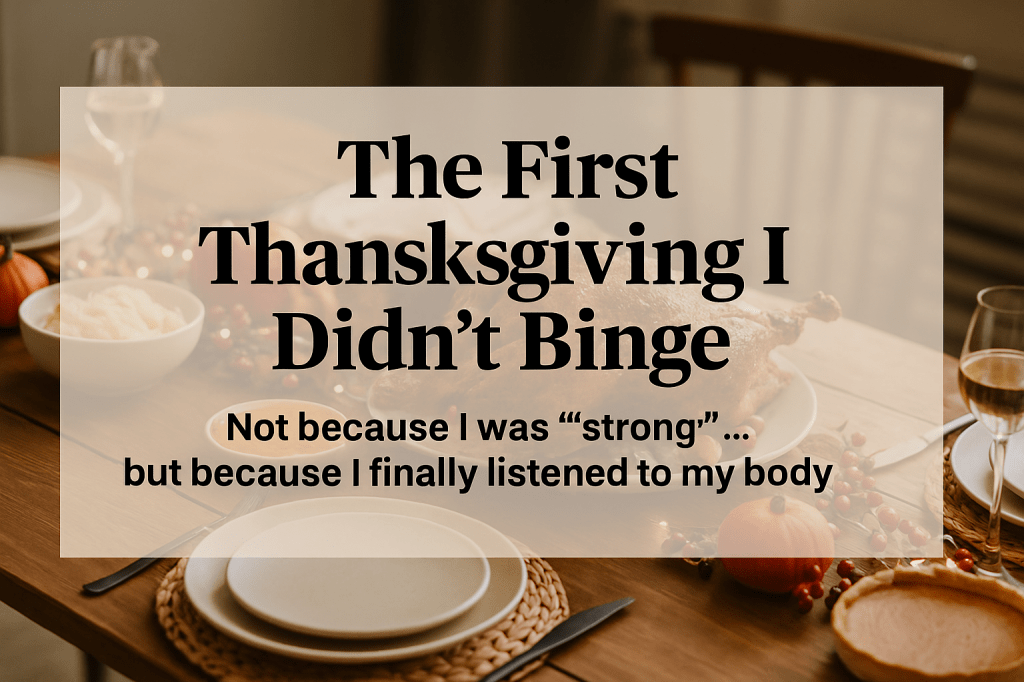
  • How I Made It Through Thanksgiving Without Bingeing for the First Time

    Lately, I’ve been really intentional about stepping away from weight loss as a goal. Not because I don’t want to lose weight eventually… but because I finally understand something huge:

    If I don’t rewire my brain first, any weight I lose will just come right back.

    My brain has been wired since childhood to use food for comfort. Full stop. End of story. And until I address that, I can diet all I want, but nothing will change long-term.

    So right now, I’m focusing on two things:

    Consistency
    and
    Mindful eating.

    These are the two areas I’ve struggled with the most—especially when life gets chaotic.


    Thanksgiving Was the Test… and My Brain Wanted Comfort Food SO Badly

    Thanksgiving break last week was rough in all the ways that usually send me spiraling:

    • Family gatherings
    • Cooking and planning
    • Hosting friends
    • Kids home all day
    • Sensory overload
    • Stress
    • Noise
    • Emotional tension

    And, of course, a big one: my husband and I weren’t getting along.

    In the past, any one of these things would have been enough to push me straight into a binge.

    But this year, I made myself a promise:

    No matter what happens, stay consistent with mindful eating.
    Not perfect. Not restrictive. Just consistent.

    Because here’s the truth:
    Food doesn’t solve any of those problems.
    Not the stress.
    Not the overwhelm.
    Not the noise.
    Not the fighting.
    Not the exhaustion.

    If anything, it makes everything worse because afterward comes the anxiety, the guilt, the bloating, and the crash.


    So This Year, I Did Something Different

    Even through all the chaos, I slowed down.

    I listened to my body.

    I ate when I was hungry.

    I stopped when I was satisfied — not stuffed.

    I even did that at the Thanksgiving meal.
    No seconds.
    No rushing.
    And yes, I had pie.

    But I actually enjoyed the pie. I savored it without guilt, without fear, without using it as a shield to block out my feelings.

    And the most shocking part?

    I didn’t binge even once.

    I truly don’t think that has ever happened to me on a holiday. Maybe not since I was little.


    Rewiring My Brain, One Thought at a Time

    The real work wasn’t the eating — it was the thinking.

    There were moments where my thoughts said:

    “Just eat the leftover pie. It’s in the fridge.”

    Old me would’ve either fought the thought using willpower (and lost)…
    or obeyed it instantly.

    But this time, I watched it.

    I didn’t argue with it.
    I didn’t shame it.
    I didn’t cling to it.
    I just observed:

    Do I actually want pie right now?

    And the answer was an immediate, solid no.

    So I had a coconut bar instead — something that tastes amazing to me, satisfies me, and doesn’t make my blood sugar crash or leave me bloated like pie does.

    It wasn’t about choosing the “healthy” option.
    It was about choosing what I actually wanted.


    I’m Not Focusing on What I Eat — I’m Focusing on How and Why

    This is the foundation I never built before.

    This — the slowing down, the emotional awareness, the consistency, the self-trust — is the work that prevents binges.

    This is the work that heals.

    This is the work that allows the weight to release naturally later, without forcing it, without punishing myself, and without white-knuckling through cravings.

    Right now, I’m not counting calories.
    I’m not restricting.
    I’m not trying to be perfect.
    I’m not chasing a number on a scale.

    I’m fixing the fundamentals I’ve ignored for years.

    Because when my why is in the wrong place, my how will always follow.

    And that’s exactly why the binges happen.

    So this season of my life is about:

    ✨ Choosing consistency over perfection
    ✨ Eating mindfully, not mindlessly
    ✨ Listening to my body, not my stress
    ✨ Rewiring my brain with patience rather than force
    ✨ Being gentle but firm with myself
    ✨ Building trust again, one meal at a time

    And honestly?
    It feels like the first time I’m truly making progress.

  • Breaking the Weekend Binge Cycle: Choosing Consistency Over Cruelty

    Last weekend was Halloween, and I let myself go completely wild. I told myself it was okay — it’s Halloween, after all — and gave myself permission to eat whatever I wanted. That “permission” turned into opening the floodgates, and I ended up gorging myself all weekend long.

    Every night I ate until I felt sick. I couldn’t sleep well, my body was overloaded, and by Monday, I felt physically awful and emotionally wrecked. I even had alcohol on Halloween, which only made things worse — I regretted it the moment I realized how terrible my sleep and anxiety were afterward.

    By Monday morning, I was exhausted, foggy, and anxious. The more I’ve reflected on my past binges, the clearer it’s become: the anxiety always follows. And it’s usually tied to sugar — the more sugar I eat, the more anxious and hopeless I feel in the days after.

    That’s when I made a decision.

    I decided to stop being cruel to myself.
    I decided that I deserve consistency.
    I decided that I deserve a healthy, fit body and a calm, stable mind.

    Because the truth is, gorging myself on food isn’t self-care — it’s self-destruction. And I’m done with that.


    When I Binge, I Disconnect

    When I’m in binge mode, I completely check out. I get irritable, I ignore my kids, I ignore my husband, and I scroll mindlessly on my phone. It’s like I’m not even there. And it can last the entire weekend — once I binge one night, I almost always continue through Sunday.

    Weekdays aren’t the problem anymore; I’ve built better structure during the week. But weekends? My brain still automatically associates them with indulgence and “freedom.” It’s a pattern I’ve repeated so often that it’s now a habit.

    My brain has learned that weekends = sweets, overeating, and escape.
    Now, it’s time to teach it something new.


    Reprogramming My Mind

    This week, I took a gentler approach. Instead of diving into restriction (which only backfires), I allowed myself to binge on fruit if I felt the urge. It’s helping me transition out of the old pattern without the all-or-nothing thinking.

    And moving into the next week, I’m setting small, consistent goals:

    Eat one meal mindfully every day. I struggle with this, especially at dinner when I’m starving and distracted by my kids. I want to practice slowing down, chewing thoroughly, and actually enjoying my food.

    Increase my hydration. I know how much better I feel when I’m drinking enough water.

    Walk at least 6,000 steps a day. Nothing extreme — just enough to move my body and clear my head.


    Each morning, I also spend a few minutes visualizing what it feels like to be at my healthiest weight — strong, confident, and at peace in my body. It’s my reminder that this journey isn’t about punishment; it’s about becoming who I’m meant to be, one small step at a time.


    Why I’m Sharing This

    I’m writing all of this because I know I’m not the only one who struggles. The guilt, the frustration, the feeling of hopelessness — it’s real, and it’s heavy. But I’m ready to change, and I want to help others who feel stuck in the same cycle.

    Because it really does start with mindset.

    My old mindset made me believe I needed to “let go” on weekends to feel free. My new mindset is learning that freedom comes from consistency, not chaos. It’s about teaching my brain that weekends are safe — I don’t need to go into survival mode.

    So this is where my next chapter begins: with small, steady steps toward peace, health, and self-respect.


    If you’re reading this and you relate — you’re not alone.
    This journey is hard, but it’s possible. And we’re worth every effort it takes to heal.

  • Finding My Groove: Showing Up for My Kids (and Myself)

    This week has felt different — in the best way. For a long time, I was just going through the motions as a mom. I was there physically, but my mind was everywhere else: thinking about work, my to-do list, what to make for dinner, or just waiting for bedtime so I could finally relax.

    But lately, I’ve found my groove. And it’s changing everything.


    Healing My Nervous System

    The biggest shift started with me. For years, I was living in constant fight-or-flight mode — rushing, reacting, trying to control everything. No wonder I didn’t have the capacity to be fully present with my kids.

    Over the last few months, I’ve been intentionally healing my nervous system, which has looked like:

    • Releasing trapped emotions that were stuck in my body and weighing me down.
    • Feeling my heart more instead of staying numb or disconnected from my emotions.
    • Meditating regularly, even for just a few minutes a day, to slow my thoughts and reconnect with my breath.
    • Choosing slow, intentional movement (like walking, stretching, or gentle yoga) instead of always rushing from task to task.
    • Doing less throughout the day and letting go of the guilt for not being “productive” every second.
    • Somatic exercises to bring my body back to a state of safety and regulation.

    Bit by bit, my body has started to feel safe again — and that safety has opened up space for connection.


    A Huge Realization

    This past weekend, I uncovered something huge about myself. Growing up as a middle child, I didn’t get much attention. And now, as an adult, I notice how that’s been showing up everywhere: craving attention from my husband, wanting my kids to notice me, even seeking it from my work team.

    Realizing this was eye-opening. It helped me see why giving my children undivided attention matters so much. I don’t want them to grow up feeling unseen the way I often did. Instead, I want them to feel deeply loved, heard, and valued — not through big gestures, but through the simple act of me being present with them.


    The Power of Presence

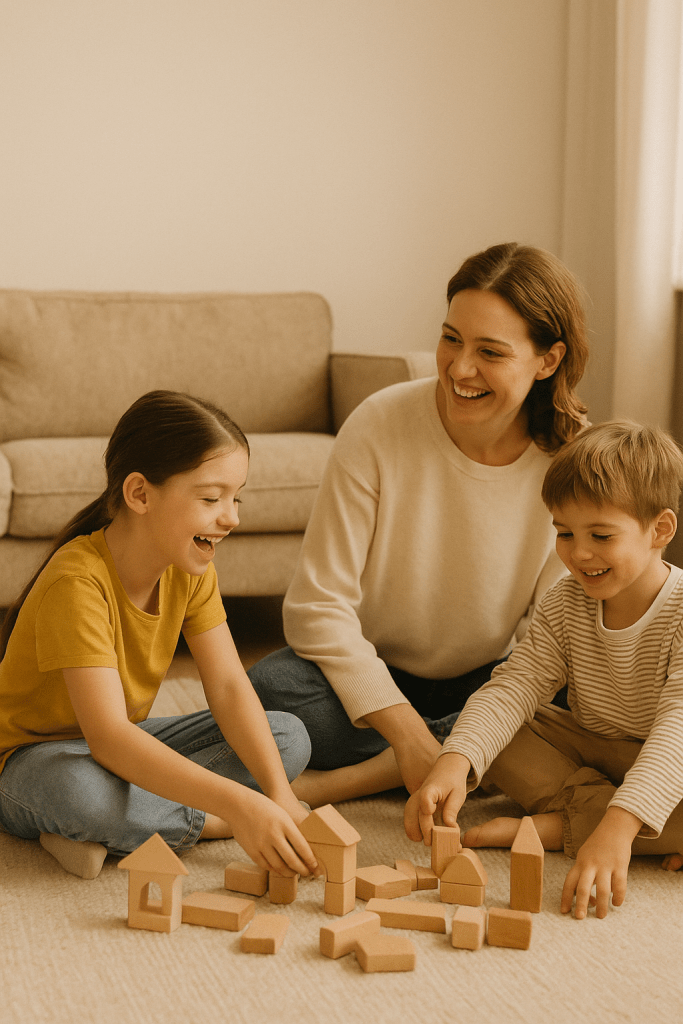
    Now that I feel calmer inside, I can actually show up for my kids. Not distracted, not halfway listening while I scroll my phone or mentally plan tomorrow. Just there — noticing the silly things they say, getting on the floor to play, and being interested in what lights them up.

    And you know what? Their behavior has changed. There are fewer meltdowns, fewer sibling fights, and way more giggles. When I’m grounded and engaged, they feel safe and seen. And when they feel that way, everything runs more smoothly.


    How I’m Making It Possible

    I’ve realized that showing up for my kids starts with showing up for myself.

    • Daily Movement – Moving my body every day helps me process stress and reset my mind.
    • Choosing Foods that Support Me – I’ve been cutting back on sugar, not from a place of restriction, but because I feel so much better without the highs and crashes.
    • Little Moments of Joy – Reading a few pages of a book, taking a hot shower, or sipping tea before bed fills me up so I can pour into my family.

    These small habits are helping my nervous system stay regulated, which means I can respond with patience instead of reacting out of stress.


    The Ripple Effect

    I didn’t expect the shift in my energy to ripple into my whole house, but it has. The mornings feel calmer. Playtime feels lighter. Even bedtime feels less like a battle and more like a connection point.

    And maybe that’s the secret — when I take care of me, I have the capacity to take care of them, too. And when I make sure my kids feel truly seen, I’m breaking a generational pattern of disconnection.


    Your Turn

    If you’ve been stuck in survival mode, I see you. Healing doesn’t happen overnight, but you can start today. Take a deep breath, release some tension in your body, choose one thing that feels nourishing — and most importantly, give your kids a few moments of undivided attention. It might change more than you think.

  • When Healing Feels Messy: Why Not Giving Up Matters Most

    It’s been a while since I’ve written here—life pulled me in a hundred directions, and in the middle of it, I lost touch with my rhythm. I’ve been busy with work, I’ve been struggling with daily nausea, and I’ve fallen away from mindful eating. If I’m honest, I’ve found myself binging again, too.

    That part is hard to admit, but it’s the truth. For me, food freedom and mindful eating aren’t just practices—they’re lifelines. When I drift from them, I feel it. I feel disconnected from myself.

    And yet, here I am, writing again. That’s the point I keep coming back to: the important thing is not that I never slip, but that I never give up.


    Healing Isn’t Linear

    I used to think once I figured out mindful eating, I’d be set forever. But healing doesn’t work like that. It’s messy. It loops back on itself. There are good weeks, and then there are weeks where old patterns sneak back in. That doesn’t erase progress—it just means I’m human.

    I’ve been reminded lately that challenges with my health, stress, and life in general will sometimes knock me off track. And when that happens, I have a choice: I can label myself as a failure, or I can see it as part of the journey and gently step back onto the path.


    Why I’m Not Giving Up

    Every time I return to mindful eating, I feel more grounded. Every time I choose to pause before a meal, even for a breath, I remember that I’m capable of showing up for myself. Every time I share here—even after weeks away—I remind myself that honesty and persistence matter more than perfection.

    Not giving up doesn’t mean forcing myself to “do better.” It means allowing myself to begin again, no matter how many times it takes.


    If You’re Struggling Too

    Maybe you’ve been feeling off track lately. Maybe you’ve slipped back into old patterns or feel like your body is working against you. If that’s you, I want you to hear this: you’re not alone, and you haven’t failed.

    The most important thing you can do is not give up. Take one small step today—pause before your next meal, sip water slowly, breathe, or even just notice what you’re feeling without judgment. These tiny choices add up.


    One Bite, One Moment at a Time

    I’m reminding myself that food freedom doesn’t come from doing everything perfectly—it comes from the decision to keep showing up, one bite and one moment at a time.

    So here’s to beginning again, as many times as we need to.

  • Mindful Presence: Finding Sweetness in the Moment (Not in the Pantry)

    There was a time when I didn’t even realize how often I was reaching for sugar just to soothe myself through the chaos. A moment of frustration, a tired afternoon, a noisy room full of tiny voices calling “Mom!” on repeat — and suddenly I’d be halfway through a pack of chocolate chips, barely remembering how they got into my hand.

    But lately, I’ve been practicing something different.

    I’m learning to come back to the moment — especially with my kids. Not the perfect, Instagram-worthy moment, but the messy, beautiful, in-between ones: when my son is telling me a long story about his latest Minecraft creation, or when my daughter wants to show me the same jump for the tenth time. Those are the moments I used to try to escape with sugar. Now, I’m trying to be in them instead.

    One thing I’ve noticed: the more I resist the present moment, the more I try to control everything around me — especially my kids. I tighten up. I start snapping, micromanaging, needing everything to be just so. But when I soften into what’s actually happening, even if it’s inconvenient or chaotic, I’m a lot more grounded. The urge to control fades. The need for sugar fades too.

    The other day I was outside with the kids, and I felt that familiar surge of overwhelm as my mental to-do list started spiraling: I should be working, I should be cleaning, I should be catching up. I could feel the pressure in my chest building, thoughts racing. But instead of getting swept up in it, I noticed the chaos in my head. I deepened my breath. And I looked at my kids.

    They were just… playing. Laughing. Being kids.

    So I stayed. I chose to watch them, to really see them — and suddenly, everything softened. I felt so grateful for that moment: my kids playing together, the sunshine on my skin, the stillness that was waiting for me underneath all that mental noise. That presence was everything. And it was so much sweeter than anything I could have found in the pantry.

    This isn’t about guilt or being the perfect parent. It’s about choosing presence over autopilot. Choosing connection over comfort food. Choosing to feel what’s happening instead of numbing it away.

    And honestly? It’s not always easy. Sometimes I still get the urge to disappear into a bag of trail mix or sneak a handful of something sweet while no one’s looking. But I’m getting better at pausing. Breathing. Noticing.

    And when I do that — when I stop resisting and just let the moment be what it is — I often realize the thing I was running from isn’t as scary or overwhelming as it felt. Sometimes I even find joy in it.

    So now, when I feel that pull to run to the pantry, I try to ask myself:

    What if the sweetness I’m craving is already right here?

    Because one day, the toys won’t be scattered everywhere. The interruptions will quiet. And I know I’ll miss it — all of it. These days are fleeting, and I want to live them, not numb my way through them.


    ✨ Try This: A Simple Presence Practice

    Next time you feel yourself spiraling with stress or reaching for sugar out of habit, try this tiny reset:

    1. Pause.
    2. Put one hand on your heart or belly.
    3. Take three slow, deep breaths.
    4. Name one thing you can see, one thing you can hear, and one thing you can feel.
    5. Whisper to yourself: “I’m safe to be here now.”

    It might seem small, but this shift can help you return to your body — and to the life that’s happening around you.


    🌱 Presence Reminders for Daily Life

    Here are some gentle cues I’ve used to reconnect when I feel myself slipping into control or autopilot:

    – Every time I sip my water, I take a breath and come back to my body.
    – When my child says “Mom!” for the tenth time, I use that as a grounding moment instead of a trigger.
    – I leave my phone in another room while spending time with my kids, even just for 10 minutes.
    – I keep a sticky note nearby that says “This is the moment.”


    🧡 One Moment is Enough

    If you’re reading this and feeling like it’s hard to be present — you’re not alone.
    But maybe today, you can choose one moment to slow down and stay.
    One moment to soften instead of control.
    One moment to breathe and look around you, just like I did outside with my kids.
    That one moment is enough. And it’s a start.

  • When I Let Go of the To-Do List, I Found My Kids Again

    Lately, I’ve been feeling like I’m holding up the entire house with two tired hands.

    The dishes.
    The laundry.
    The meals.
    The kids’ emotions.
    My own emotions.
    The invisible checklist that loops through my mind from morning to night.

    And recently, something in me whispered: This isn’t sustainable.

    The weight I’ve been carrying—physically, emotionally, mentally—has felt heavier than ever. Especially with my husband checked out lately, glued to the TV, barely present with the kids. I know he’s struggling too—he’s said it’s depression from losing his job—but knowing that doesn’t make it easier when I feel like I’m parenting alone.

    I’ve tried to push through.
    Tried to be efficient.
    Tried to manage everyone and everything like I’m some kind of machine.

    But I’m not.
    And I don’t want to be.

    So yesterday… I stopped.

    I didn’t plan on it. But something in me just surrendered. I let the to-do list sit where it was. I let go of trying to be “productive.” I didn’t force myself to multitask or squeeze in extra chores while my kids played.

    I played with them.
    Fully.
    Presently.
    Joyfully.

    And something wild happened… I felt alive again.

    I had fun. Real fun—not that fake, “I’m-smiling-but-thinking-about-dinner” kind of fun. I laughed. I chased them. I watched their faces light up and realized how long it’s been since I truly joined in their world.

    And the to-do list?
    It still got done.
    Not all at once. Not on a strict timeline. But enough.

    I’ve been noticing this pattern in myself: the more I resist what’s happening, the more I try to control everything around me. And when I do that, I feel more stressed, more reactive, more exhausted. But when I pause… when I breathe… when I accept what’s in front of me and meet it with presence—something shifts.

    There’s more peace.
    More grace.
    More room for me and the kids to just be.

    And while I still feel that familiar tug toward “getting everything done,” I’m learning that presence is productivity too.
    That being with my children, fully, is not a break from my job—it is the most important part of my job.

    So today, I’m choosing that again.
    Even if it’s messy.
    Even if the laundry piles up.
    Even if dinner is just chicken nuggets and cut-up fruit.

    I’m choosing presence over perfection.
    Connection over control.
    And joy—real joy—over just making it through the day.

    1. Letting the to-do list go (just for a little while)
      I didn’t abandon responsibility—I just pressed pause. I reminded myself that the dishes could wait, the laundry would still be there later, and that I could trust time to stretch a little if I chose to be present now. Releasing that inner urgency made space for joy.
    2. Breathing before reacting
      When I noticed overwhelm or frustration bubbling up, I put my hand on my chest and just took a slow, deep breath. It didn’t fix everything, but it gave me a pause—a window where I could respond gently instead of snapping or zoning out. That breath anchored me to now.
    3. Saying yes to play
      Instead of trying to get the kids to “go play” so I could do something else, I stepped into their world. Even five minutes of full-body, full-heart play shifted the energy in our home. It reminded me that joy is right here when I choose to engage in it.

    You’re Not Alone

    If you’re a mom feeling overwhelmed, like you’re constantly doing everything for everyone else—please know this: you are not failing. You’re just carrying too much. And sometimes the most powerful thing we can do is let something go and be right here, just for a moment.

    You deserve joy too.

    Let the house be a little messy. Let the list wait. Let your heart rest in the giggles, the sunshine, the tiny hands pulling you into their world.

    It’s not perfect. It’s presence.
    And that’s more than enough. 💛