Stories about life, food, and becoming—with simple, satisfying recipes for real life.

weight-loss

  • When a Weight-Loss Goal Quietly Became a Deadline

    When a Weight-Loss Goal Quietly Became a Deadline

    A few days ago, I did some math.

    Which is always dangerous when weight loss is involved.

    We’re planning to start trying for another baby in a few months, and naturally, I’ve been thinking about my weight.

    I’d like to lose more before I get pregnant.

    So my brain did what brains do when you give them a goal and a timeline.

    Okay. If I lose about five pounds a month…

    I started calculating.

    And I realized I could potentially get down to around 170 pounds by the time we start trying.

    170.

    That sounded good.

    Really good.

    And apparently somewhere between doing that math and continuing on with my life, 170 stopped being a possibility.

    It became a deadline.

    I didn’t consciously decide that.

    I didn’t write:

    MUST WEIGH 170 BEFORE GETTING PREGNANT

    on my bathroom mirror.

    I didn’t start some extreme diet.

    Nothing changed dramatically.

    It was much quieter than that.

    I just started thinking:

    How can I lose weight faster?

    And then little things started happening.

    I’d recently stopped having an afternoon snack.

    Lunch to dinner.

    I can make it.

    I’m not that hungry.

    I don’t really need a snack.

    Totally reasonable.

    I also realized I’d basically stopped drinking water in the afternoons.

    At the same time, I’d recently started doing Pilates twice a week.

    And I’m in my luteal phase.

    Then suddenly…

    I was fucking hungry.

    Especially at night.

    I started eating more in the evenings.

    I started having cravings again.

    And my first instinct was to look at the nighttime eating.

    Because obviously that’s the problem, right?

    Why am I suddenly eating more at night?

    Why am I having cravings again?

    How do I stop doing this?

    Except then I started looking at what was happening earlier in the day.

    And I thought:

    Oh.

    Maybe nighttime isn’t actually where this starts.

    Maybe trying to make it from lunch to dinner without eating has something to do with being really hungry later.

    Groundbreaking stuff over here.

    Now, I don’t actually know exactly what’s causing the increased hunger.

    Maybe skipping the afternoon snack is contributing.

    Maybe Pilates has increased my appetite.

    Maybe being in my luteal phase is part of it.

    Maybe I’m thirsty.

    Maybe it’s several things happening at once.

    I don’t know.

    But I do know something else.

    The pressure had started changing my behavior.

    That’s the part that got my attention.

    I wasn’t walking around thinking:

    I need to restrict my food.

    I wasn’t consciously starving myself.

    It sounded much more innocent inside my head.

    I don’t need an afternoon snack.

    I can wait until dinner.

    How can I lose weight a little faster?

    And individually, none of those thoughts seemed particularly alarming.

    But when I zoomed out, I could see what was happening.

    I’d given myself a deadline.

    I had a few months.

    I wanted to get as much weight off as possible.

    And suddenly every opportunity to eat a little less became an opportunity to get closer to 170.

    That’s restriction too, isn’t it?

    Or at least it can be.

    Maybe restriction doesn’t always announce itself with a meal plan and a list of forbidden foods.

    Maybe sometimes it sneaks in wearing a very reasonable outfit.

    You can wait.

    You don’t really need that.

    You’re trying to lose weight, remember?

    And this is where the whole thing started bothering me.

    Because food has finally gotten quieter for me.

    Really quiet.

    I’ve stopped starving myself.

    I eat breakfast.

    Lunch.

    Dinner.

    I feed myself.

    And somehow, after spending so much of my life believing I needed more control around food, I’ve started trusting myself around it.

    That feels huge.

    And now here I was potentially messing with that peace because I had decided I should weigh 170 pounds by a certain date.

    No.

    I don’t want that.

    I want to lose weight.

    That’s still true.

    I’d love to go into another pregnancy at a lower weight.

    Also true.

    And if someone offered me a magical button right now that safely dropped me to 170 pounds, I would not nobly decline it in the name of personal growth.

    I would smash that thing.

    Repeatedly.

    I’m not pretending I suddenly don’t care about weight loss.

    I do.

    That’s what makes this complicated.

    But I think I’m starting to care about something else more.

    The relationship with food I’ve been building.

    The trust.

    The quiet.

    The ability to eat when I’m hungry without immediately wondering whether I should have been able to go longer.

    I don’t want to sacrifice all of that just so I can squeeze as much weight loss as possible into the next few months.

    And that realization made me think I might stop weighing myself for now.

    Not because I think the scale is evil.

    Not because I’ve transcended caring what I weigh.

    Clearly I have not.

    But because I know myself.

    If I keep watching that number while there’s a countdown running in the background, I know how easily I’ll start doing the math.

    If I lose this much this week…

    If I lose five pounds this month…

    If I can just get to…

    And suddenly I’m not taking care of myself anymore.

    I’m managing myself toward a deadline.

    Even deciding not to weigh myself has this sneaky little trap in it.

    Because I could easily say:

    Fine. 170 doesn’t matter.

    I’ll stop weighing myself.

    But hopefully I can still lose ten pounds before we start trying.

    Nice try.

    That’s just 170 wearing a fake mustache.

    It’s the same assignment.

    The same pressure.

    The same countdown.

    And I don’t want to replace one secret goal with another one and pretend I’ve let go.

    So I’ve been trying to ask myself a different question.

    Instead of:

    I have a few months before we start trying to conceive. How much weight can I lose?

    What if it’s:

    I have a few months before we start trying to conceive. How well can I take care of myself?

    That feels completely different.

    Can I keep doing Pilates?

    Can I walk?

    Can I drink some damn water in the afternoon?

    Can I eat a snack when I’m hungry instead of congratulating myself for making it to dinner?

    Can I arrive at trying to conceive still trusting myself around food?

    And if I lose weight while I’m doing that?

    Great.

    Seriously.

    I hope I do.

    But maybe the number doesn’t get to be the assignment anymore.

    Because I’ve spent a lot of time getting to this weirdly peaceful place where food is becoming…

    food.

    Not a moral test.

    Not an escape.

    Not something I need to earn.

    Not something I need to spend all day trying not to eat.

    Just food.

    And I don’t want to trade that for 170.

    Even writing that feels strange.

    Because part of me still really, really wants 170.

    Both things can apparently be true.

    I want to lose weight before getting pregnant.

    And I don’t want wanting to lose weight before getting pregnant to become more important than taking care of the person who’s actually going to be pregnant.

    I also can’t say the pressure or the missing afternoon snack caused the increased hunger and cravings.

    Bodies are more complicated than that.

    But I don’t actually need to prove causation to recognize a pattern in myself that I don’t like.

    How can I lose weight faster?

    That’s the thought I want to pay attention to.

    Not because wanting to lose weight is wrong.

    But because I know how easily, for me, wanting it faster can turn into something else.

    So I have no idea what I’ll weigh when we start trying.

    Part of me really hates that sentence.

    She would like a spreadsheet.

    A projection.

    Preferably a graph.

    She would like to know exactly where we’re going to land.

    But maybe she doesn’t get to know this time.

    Maybe these next few months aren’t about arriving at the lowest possible weight.

    Maybe they’re about arriving there still trusting myself.

    And right now, that feels like something worth protecting.

  • I Thought I Was Becoming the Old Me Again

    I Thought I Was Becoming the Old Me Again

    Last weekend, I got high and ate a lot of Cheetos.

    Like.

    A lot of Cheetos.

    Which is not exactly how I planned to start this story, but here we are.

    I haven’t eaten like that in a long time.

    And then the next day, I finished the rest of the bag.

    So that was fun.

    A few days later, my husband took me out to lunch.

    Normally, I probably would have looked through the menu for something a little healthier. Not necessarily because I was forcing myself to eat healthy, but because that’s genuinely how I eat most of the time now.

    But I wanted a burger.

    And sweet potato fries.

    So I ordered a burger and sweet potato fries.

    I ate them.

    They were delicious.

    I stopped before I got really full.

    And then I ate normally for the rest of the day.

    Nothing particularly interesting happened.

    Which, I’m realizing, is actually kind of the point.

    Then my friend came over.

    We played games. We watched three movies. We got tacos from a restaurant.

    Later, I ate some frozen berries.

    And at some point during all of this, I went upstairs to put my kids’ candy away.

    I asked my friend if she wanted some before I put it away.

    She said yes.

    So apparently my brain interpreted that as:

    Great. Candy for everyone.

    And I grabbed a bunch for myself too.

    Not a couple pieces.

    A bunch.

    I brought it downstairs, sat on the couch, and ate all of it while we watched the movie.

    And afterward?

    I felt like shit.

    Not emotionally.

    Physically.

    My stomach didn’t feel good. My body didn’t feel good. And I remember having this very anticlimactic realization:

    Oh yeah.

    This is why I don’t really eat candy anymore.

    It wasn’t some virtuous health realization.

    It just didn’t feel good.

    And then it messed with my sleep.

    Which gave me plenty of time to lie awake and turn the whole thing into something much bigger.

    Because apparently 2 a.m. is an excellent time for a personal investigation.

    Why did you do that?

    Are you going back to your old patterns?

    What if this is the beginning of slipping backward?

    And my brain had receipts.

    There had been the Cheetos.

    Then more Cheetos.

    The burger and fries.

    Tacos.

    Candy.

    It had been several days of eating more restaurant food, snack food, and “junk food” than is normal for me.

    And suddenly it wasn’t just candy anymore.

    It was evidence.

    Maybe I was slipping.

    Maybe those old patterns weren’t as far behind me as I’d thought.

    Maybe this was how it started.

    And for a little while, I was genuinely scared.

    Because I remember the old version of me.

    She could turn one night of overeating into an entire event.

    There would be guilt.

    There would be calculations.

    There would probably be some kind of plan for the next day.

    Eat less.

    Skip something.

    Make up for it.

    Get back under control.

    Or—and this was always a fun alternative—I could go completely the other direction.

    Well, I already screwed up.

    Might as well keep going.

    I’ll start again tomorrow.

    Or Monday.

    Obviously Monday.

    One night could spill into the next day because I’d already blown it anyway.

    Eating “badly” became evidence that I was failing.

    And once I’d failed, there was this weird permission to keep failing.

    Until eventually I felt shitty enough that I needed to regain control again.

    And then we’d start the whole thing over.

    So lying there that night, worrying that maybe I was becoming that version of myself again, I started thinking about what I was going to do the next day.

    And that’s when something didn’t quite fit.

    Because I already knew what I was going to do.

    Nothing.

    Literally nothing.

    I wasn’t going to skip breakfast.

    I wasn’t going to have some sad tiny lunch to compensate for the candy.

    I wasn’t going to calculate how many calories I needed to undo.

    I wasn’t going to swear off sugar.

    And I also wasn’t thinking:

    Well, I’ve been eating like shit lately anyway, so screw it.

    I was just going to…

    eat normally.

    Breakfast when I was hungry.

    Lunch.

    Dinner.

    Whatever I normally would have eaten.

    And that realization kind of stopped me.

    Because here I was lying in bed worried that I was slipping back into my old relationship with food…

    while responding to overeating in a way the old me probably couldn’t have imagined.

    I still trusted myself.

    That surprised me.

    Because somewhere in my head, I think I’d created this idea that having a better relationship with food would eventually mean I wouldn’t do things like this anymore.

    I wouldn’t overeat.

    I wouldn’t eat past the point that felt good.

    I wouldn’t worry about gaining weight afterward.

    But apparently that’s not where I am.

    I ate more than felt good.

    I regretted it.

    I had anxiety afterward.

    None of that magically disappeared.

    But something underneath it had changed.

    I could regret how I’d eaten without turning that regret into punishment.

    I could worry about gaining weight without obeying that fear the next morning.

    I could have several days where I ate differently than I normally do without deciding that this was my life now.

    And maybe that’s actually a much bigger deal than never overeating at all.

    Because if my peace with food depends on me always eating exactly the “right” amount…

    that’s not much peace.

    That’s pretty fucking fragile.

    If one bag of Cheetos and a pile of candy can destroy it, then I haven’t really built anything new.

    I’ve just created another set of conditions I have to follow.

    Maybe the fact that things got a little messy and the trust was still there tells me more than several perfect weeks ever could.

    Because maybe becoming someone new doesn’t mean the old behavior becomes impossible.

    Maybe it means the old behavior doesn’t have the same power anymore.

    I can do something the old me would have done without becoming the old me again.

    Which is especially interesting timing because we’re going to Disneyland later this month.

    And after this happened, I’ll admit, that made me nervous.

    Disneyland is not exactly known for its abundance of sensible little salads.

    There will be restaurant meals.

    Snacks.

    Desserts.

    Things shaped like Mickey Mouse that I will undoubtedly believe taste better because they are shaped like Mickey Mouse.

    And for a minute, I wondered:

    What if I can’t trust myself there?

    But then I realized this whole experience might actually be evidence that I can.

    Not because I’m going to Disneyland planning to eat perfectly.

    I’m not.

    I want to eat things that sound good.

    I want to enjoy the things that are actually worth enjoying.

    And mostly, I just want to eat like I normally do—except I’ll be at Disneyland.

    I might eat too much one night.

    I might have a dessert that wasn’t remotely worth it.

    I might eat something just because everyone else is eating it.

    Apparently that’s allowed too.

    Because now I know what happens the next morning.

    I eat breakfast.

    That’s it.

    And somehow, that feels enormous.

    Because maybe I’ve been looking for evidence of change in the wrong place.

    Maybe the evidence isn’t that I never do something the old me would have done.

    Maybe it’s what happens afterward.

    The old version of me would either punish herself for yesterday or use yesterday as an excuse to keep going.

    I don’t have to do either anymore.

    I can do something the old me would have done without following her all the way down the road.

    One night can just be one night.

    And maybe I trust myself enough to know that tomorrow…

    I’ll just eat breakfast.

  • Fat Is Not My Identity

    Fat Is Not My Identity

    I was holding one of our new kittens the other day.

    I sat down with her, hoping she’d finally just curl up on me for a minute.

    She immediately took off.

    “She never just wants to lay on me when I sit down,” I said.

    And my son, with the completely unfiltered honesty only a kid can deliver, said:

    “Well, maybe it’s because you’re kinda fat.”

    Cool.

    Cool cool cool.

    There are certain things your child can say that you know, logically, were not designed to emotionally destroy you.

    And then there are the things they say that somehow locate your deepest insecurity, walk directly up to it, and punch it in the face.

    This was the second kind.

    Because my first thought wasn’t:

    He’s a kid. He doesn’t understand what that word means to me.

    It wasn’t:

    The kitten is a kitten and probably just wants to run around.

    It wasn’t even:

    Ouch.

    It was:

    Yeah. I am just a fatty.

    And then:

    Why would she want to sit on my fat lap?

    And then, almost immediately:

    Why even bother trying?

    And THAT is the part that gets me.

    Not that my son called me “kinda fat.”

    But how quickly my own brain took his comment and turned it into an identity.

    I wasn’t a woman who has been trying to take care of herself.

    I wasn’t a mom sitting on the couch holding her new kitten.

    I wasn’t a whole person with a body that happens to carry more fat than I want it to right now.

    I was just a fatty.

    And apparently the kitten agreed.

    Which, with approximately five seconds of emotional distance from the situation, is objectively ridiculous.

    She’s a kitten.

    I’m pretty sure she didn’t jump off my lap because she conducted a quick assessment of my body composition and decided the conditions were unacceptable.

    But shame isn’t particularly interested in logic.

    It heard one word.

    Fat.

    And it grabbed it.

    See?

    Other people see it too.

    This is what you are.

    Why even bother?

    That last one is the dangerous one for me.

    Because I’ve been here before.

    The place where not seeing the progress I want fast enough becomes a reason to stop trying altogether.

    Where one bad weigh-in becomes, What’s the point?

    Where one comment becomes, See? Nothing is changing.

    Where feeling bad about my body somehow becomes a reason to stop taking care of it.

    But this time, after the initial sting wore off, another thought came in.

    Fat is not my identity.

    I can have fat on my body.

    I can have more of it than I want.

    I can want to lose weight.

    I can actively be working toward changing my body.

    And none of that makes fat who I am.

    I don’t have to pretend my son’s comment didn’t hurt.

    It did.

    I don’t have to immediately counter it with, No! I’m beautiful! I love every inch of my body!

    That’s not even what this is about.

    This is about refusing to take something about my body and turn it into a definition of myself.

    But the more I thought about it, the more I realized I don’t just do this with my body.

    I’ve carried shame as an identity for so long that sometimes it feels like I’ve been doing it for lifetimes.

    It’s my go-to.

    It’s familiar.

    It’s addicting.

    And as uncomfortable as it is to admit, sometimes there’s even a kind of pleasure in it.

    Not because I actually want to feel terrible about myself.

    But because I know this place.

    I know how to suffer here.

    I know the thoughts.

    I’m worthless.

    Why even bother?

    I know exactly how the story goes.

    And recently, I felt myself going there again.

    Back into shame.

    Back into the familiar suffering.

    Back into those thoughts that wanted to tell me what something happening in my life meant about me and who I was.

    Except this time, I watched it happen.

    I watched that familiar suffering show up and try to claim me.

    And instead of completely disappearing into it, I could see what was happening.

    Oh.

    Here we go again.

    This is the story.

    I’ve been working really hard on recognizing these stories when they come up instead of automatically believing them.

    Not necessarily getting better at feeling them.

    But getting better at seeing them.

    I could still feel the heaviness there.

    Honestly, I can still feel it sometimes.

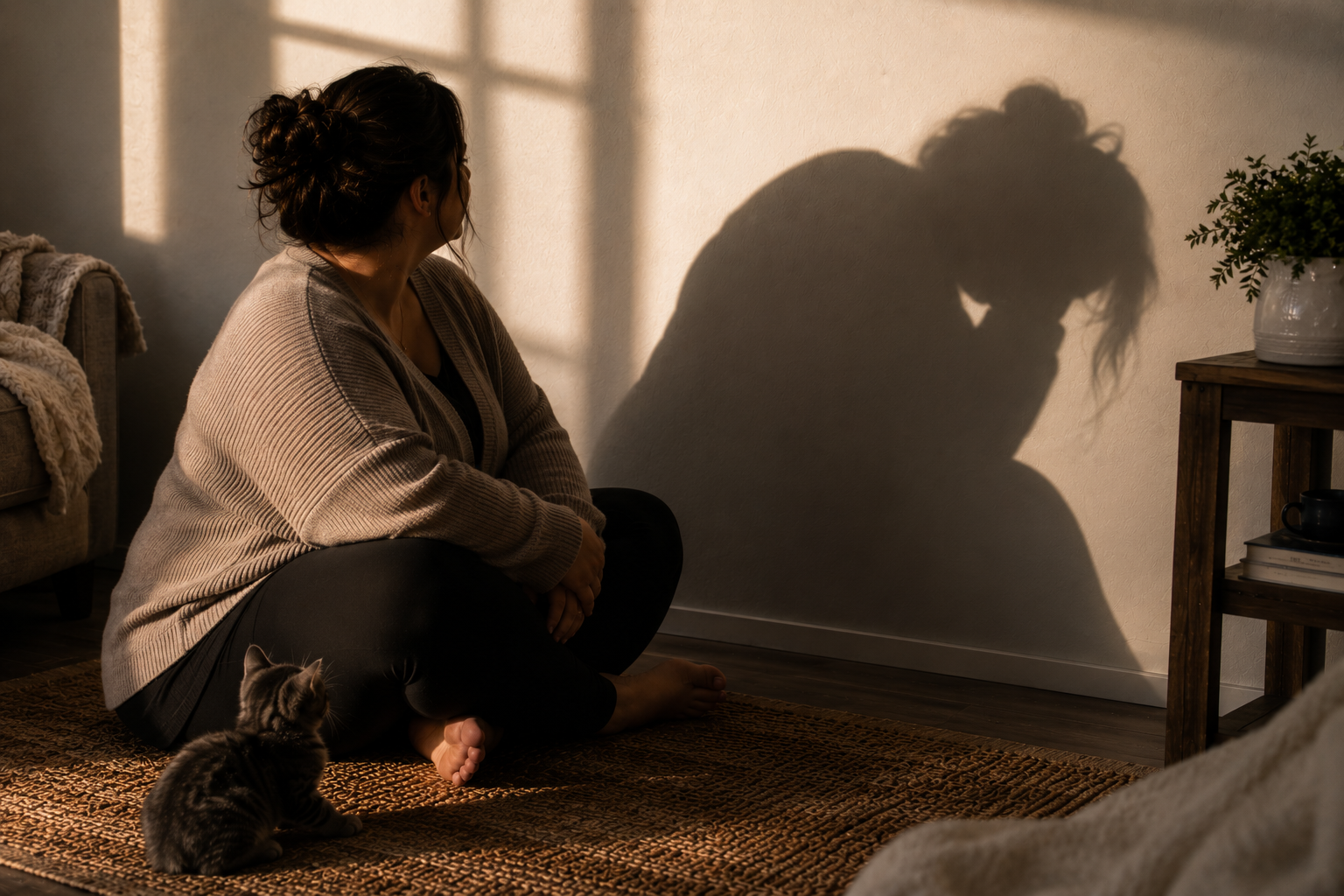
    Like a shadow hanging around, waiting for another opportunity to claim me.

    But it isn’t becoming me this time.

    And really, that’s exactly what had happened with the kitten.

    My son said one thing.

    And within seconds, shame had turned it into an entire story about who I was and why I should stop trying.

    Then I noticed something else.

    Lately, it had felt like one shameful thing after another.

    Boom.

    Boom.

    Boom.

    I was sitting there feeling all of it, listening to that familiar voice tell me:

    You’re worthless.

    Feeling that familiar shameful identity settle over me again.

    I know this version of myself.

    I’ve been her for a very long time.

    But this time, I could almost see the whole thing from the outside.

    And I thought:

    Oh my God.

    I’ve been looking at my life through a shame lens.

    Of course I’m seeing shame everywhere.

    I’m focused on the things that confirm it.

    Something happens, I interpret it through shame, I feel more shame, and then I notice the next thing that gives me another reason to feel ashamed.

    Maybe it wasn’t just one shameful thing after another.

    Maybe shame was the thing connecting them.

    And suddenly I had this little aha moment.

    If I can do that with shame…

    Can I do it with gratitude?

    If I’m constantly looking for things that confirm shame, what happens if I start looking for things to be grateful for instead?

    And if I take it even further—could focusing on gratitude actually attract more experiences into my life that give me something to be grateful for?

    I don’t know.

    But I know I’ve watched the opposite happen.

    I’ve watched shame become a lens.

    I’ve watched one experience seem to lead straight into another and another because that’s what I was looking for.

    That’s what I was expecting.

    That’s what felt familiar.

    And for a long time, I didn’t even realize I was doing it.

    I just thought that was my life.

    Maybe that’s what I’m most curious about now.

    What happens when I stop looking at my life through the emotion I’ve practiced for so long?

    What happens if shame isn’t the place I automatically come home to?

    What if I practice gratitude instead?

    I don’t know yet.

    But if I’ve spent this long practicing shame, I think I’d like to find out what happens when I practice something else.

    Because all of this started with one completely unfiltered comment from a kid who probably hasn’t thought about it again since.

    Meanwhile, I’m over here having an entire existential crisis because a kitten wouldn’t sit on my lap.

    Motherhood is magical.

    But I’m not giving up.

    Not because I’m suddenly unbothered by my body.

    I’m not.

    Not because words don’t hurt me anymore.

    They do.

    And not because shame doesn’t still know exactly where to find me.

    It does.

    I’m going to keep going because fat is not my identity.

    Shame isn’t my identity either.

    Shame can show up.

    I can feel it without letting it become me.

    But I don’t have to keep practicing it.

    And maybe now I get to decide what I practice instead.

  • Why I Had to Stop Trying to Lose Weight

    How slowing down, trusting my body, and embracing change helped me heal my relationship with food.

    For most of my life, I believed weight loss came down to discipline.

    Eat less.
    Try harder.
    Get back on track.

    If the scale wasn’t moving, it meant I needed more control. More effort. More rules.

    And for a while, that approach worked… or at least it felt like it did. The scale would move, I’d feel accomplished, and I’d convince myself that the pressure was worth it.

    But over time something started happening that I couldn’t ignore.

    The harder I tried to lose weight, the harder my body pushed back.


    The Quiet Pressure I Carried Around Food

    There was a time when I thought about weight almost every day.

    Not obsessively in an obvious way, but quietly in the background of my life.

    In the grocery store.
    While eating dinner.
    Getting dressed in the morning.
    Stepping on the scale and letting that number determine what kind of day I was about to have.

    I told myself I just wanted to be healthier. But if I’m honest, a lot of my decisions around food were driven by pressure and fear.

    And the more pressure I put on myself to “get it right,” the more my body seemed to rebel.

    Eventually that pressure would lead to the exact thing I was trying to avoid — binge eating.

    It became a cycle I knew too well.

    Try harder.
    Feel restricted.
    Lose control.
    Start over.

    Eventually I realized something surprising:

    Trying to lose weight was actually making it harder for me.


    A Season of Change

    Around the same time I started noticing this pattern, our family went through a big shift.

    My husband became a stay-at-home dad.

    If you had told me a few years ago that this would be our dynamic, I probably would have laughed. For a long time I felt like I had to hold everything together — the work, the house, the planning, the mental load.

    Letting that change happen felt uncomfortable at first.

    Who am I if I’m not the one managing everything?
    What if this doesn’t work?
    What will people think?

    Change has a way of challenging the identities we didn’t even realize we were holding onto.

    But once the dust settled, something unexpected happened.

    Life started to feel… calmer.

    The rhythm of our home softened.
    I wasn’t carrying as much tension throughout the day.
    There was more space to breathe.

    And strangely enough, that shift started affecting my relationship with food too.


    Learning to Slow Down

    Instead of chasing weight loss the way I always had, I started experimenting with something much simpler.

    I began focusing on how I was eating instead of how much.

    I started slowing down at meals.
    Actually tasting my food.
    Putting my fork down between bites.
    Drinking water and giving my body time to catch up.

    I began prioritizing foods that made me feel steady — fruits, vegetables, nourishing meals — not because I was forcing myself to eat “perfectly,” but because they genuinely made me feel better.

    There were no strict rules.

    No countdowns.

    No punishments if I ate something I “shouldn’t.”

    And something interesting started to happen.

    When I removed the pressure, my body relaxed.


    Safety Changes Everything

    One of the biggest realizations I’ve had through this process is that my body does not respond well to chaos and pressure.

    It responds to safety.

    When life feels calmer…
    When I’m not trying to control everything…
    When I trust myself around food…

    My body functions differently.

    I feel more satisfied with less food.
    I don’t obsess about what I’m eating.
    The urge to binge becomes quieter.

    For years I thought my body needed more discipline.

    What it actually needed was more trust.


    Letting Go of Control

    Stopping the constant pursuit of weight loss didn’t mean I stopped caring about my health.

    It meant I stopped approaching it from fear.

    Instead of asking, How do I lose weight?
    I started asking, How do I support my body?

    How do I nourish it?

    How do I reduce stress in my life?

    How do I create an environment where my body feels safe enough to function the way it’s supposed to?

    Ironically, when I stopped chasing weight loss so aggressively, things started to shift naturally.

    Not dramatically.
    Not overnight.

    But gently.

    And honestly, that feels much more sustainable than anything I’ve done before.


    3 Things That Have Helped Me Feel Calmer Around Food

    I’m still learning and growing through this process, but a few simple changes have made a huge difference in how I feel around food.

    1. Slowing Down at Meals

    For most of my life, I ate quickly without even realizing it.

    Recently I started doing something incredibly simple: I don’t take another bite until I’ve fully swallowed the one I’m chewing.

    It sounds small, but it has completely changed my eating experience.

    When I slow down, I actually taste my food. I notice when I’m satisfied sooner. And meals feel calmer instead of rushed.

    It also helps my body send those natural fullness signals that I used to miss when I was eating too quickly.


    2. Focusing on Nourishment Instead of Restriction

    Instead of asking myself what I should avoid, I’ve started asking a different question:

    What would nourish my body right now?

    Most of the time that naturally leads me toward foods that make me feel good—things like fruit, vegetables, balanced meals, and plenty of water.

    But it also removes the pressure that used to make food feel stressful.

    When food isn’t labeled as “good” or “bad,” it’s much easier to listen to what my body actually needs.


    3. Creating More Calm in My Life

    One thing I’m realizing more and more is that my relationship with food is deeply connected to my overall stress levels.

    When life feels chaotic, my eating tends to feel chaotic too.

    The recent shift in our family—my husband becoming a stay-at-home dad—has brought a surprising sense of calm to our home. And that calm has carried over into my body as well.

    Less stress means less urgency around food.

    And that alone has made a big difference.


    A Question for You

    Have you ever noticed that the harder you try to control something, the more resistance you feel?

    I’d love to hear your experience.

    Have you ever had a moment where letting go of pressure actually helped your body or your habits settle down?

    Or are you someone who feels stuck in the cycle of trying harder and starting over?

    Feel free to share in the comments—I read every one.

  • How I Made It Through Thanksgiving Without Bingeing for the First Time

    Lately, I’ve been really intentional about stepping away from weight loss as a goal. Not because I don’t want to lose weight eventually… but because I finally understand something huge:

    If I don’t rewire my brain first, any weight I lose will just come right back.

    My brain has been wired since childhood to use food for comfort. Full stop. End of story. And until I address that, I can diet all I want, but nothing will change long-term.

    So right now, I’m focusing on two things:

    Consistency
    and
    Mindful eating.

    These are the two areas I’ve struggled with the most—especially when life gets chaotic.


    Thanksgiving Was the Test… and My Brain Wanted Comfort Food SO Badly

    Thanksgiving break last week was rough in all the ways that usually send me spiraling:

    • Family gatherings
    • Cooking and planning
    • Hosting friends
    • Kids home all day
    • Sensory overload
    • Stress
    • Noise
    • Emotional tension

    And, of course, a big one: my husband and I weren’t getting along.

    In the past, any one of these things would have been enough to push me straight into a binge.

    But this year, I made myself a promise:

    No matter what happens, stay consistent with mindful eating.
    Not perfect. Not restrictive. Just consistent.

    Because here’s the truth:
    Food doesn’t solve any of those problems.
    Not the stress.
    Not the overwhelm.
    Not the noise.
    Not the fighting.
    Not the exhaustion.

    If anything, it makes everything worse because afterward comes the anxiety, the guilt, the bloating, and the crash.


    So This Year, I Did Something Different

    Even through all the chaos, I slowed down.

    I listened to my body.

    I ate when I was hungry.

    I stopped when I was satisfied — not stuffed.

    I even did that at the Thanksgiving meal.
    No seconds.
    No rushing.
    And yes, I had pie.

    But I actually enjoyed the pie. I savored it without guilt, without fear, without using it as a shield to block out my feelings.

    And the most shocking part?

    I didn’t binge even once.

    I truly don’t think that has ever happened to me on a holiday. Maybe not since I was little.


    Rewiring My Brain, One Thought at a Time

    The real work wasn’t the eating — it was the thinking.

    There were moments where my thoughts said:

    “Just eat the leftover pie. It’s in the fridge.”

    Old me would’ve either fought the thought using willpower (and lost)…
    or obeyed it instantly.

    But this time, I watched it.

    I didn’t argue with it.
    I didn’t shame it.
    I didn’t cling to it.
    I just observed:

    Do I actually want pie right now?

    And the answer was an immediate, solid no.

    So I had a coconut bar instead — something that tastes amazing to me, satisfies me, and doesn’t make my blood sugar crash or leave me bloated like pie does.

    It wasn’t about choosing the “healthy” option.
    It was about choosing what I actually wanted.


    I’m Not Focusing on What I Eat — I’m Focusing on How and Why

    This is the foundation I never built before.

    This — the slowing down, the emotional awareness, the consistency, the self-trust — is the work that prevents binges.

    This is the work that heals.

    This is the work that allows the weight to release naturally later, without forcing it, without punishing myself, and without white-knuckling through cravings.

    Right now, I’m not counting calories.
    I’m not restricting.
    I’m not trying to be perfect.
    I’m not chasing a number on a scale.

    I’m fixing the fundamentals I’ve ignored for years.

    Because when my why is in the wrong place, my how will always follow.

    And that’s exactly why the binges happen.

    So this season of my life is about:

    ✨ Choosing consistency over perfection
    ✨ Eating mindfully, not mindlessly
    ✨ Listening to my body, not my stress
    ✨ Rewiring my brain with patience rather than force
    ✨ Being gentle but firm with myself
    ✨ Building trust again, one meal at a time

    And honestly?
    It feels like the first time I’m truly making progress.

  • Breaking Free from Sugar Addiction: My Story and How You Can Too

    Sugar has been my constant companion for as long as I can remember. What started as an innocent treat quickly spiraled into a full-blown addiction, consuming my life, my health, and my happiness. But through years of struggle, heartache, and healing, I’ve found my way out—and I want to share everything I’ve learned with you. Here’s the quick version of my story.


    When I was around 17 or 18, still living with my parents, I was obsessed with Twizzlers. They weren’t just candy to me; they were nostalgia—memories of movie nights and camping trips. They gave me comfort, routine, and familiarity during a time of transition between adolescence and adulthood. I would sneak them into my room or nibble on them late at night while watching TV. But one day, something bizarre happened that shifted everything.

    I was in the shower when I noticed something red coming from my belly button. Panic set in. I thought I was bleeding. I threw on my bathrobe, ran to my mom, and started freaking out. But then, I dug around and pulled out a red, slimy piece. I sniffed it, and that’s when I laughed—it was a piece of Twizzlers! How it got there? I had no clue. I hadn’t even eaten any for five days. After that, my obsession with Twizzlers lost its appeal a little bit. The absurdity of the moment cracked something open in me: maybe this love affair with candy wasn’t so harmless after all.


    When I moved into an apartment with my soon-to-be husband, my sugar addiction evolved into something more secretive—and more destructive. Sour Punch Bites became my new obsession. I would walk into Target and somehow always find myself in the candy aisle, pretending I was just grabbing a few things. I remember the thrill of ripping open that bag in the car and stuffing handfuls into my mouth. I wasn’t eating for taste—I was eating to escape.

    It was a double life. I would buy huge bags, demolish them before my fiancé got home, and then pretend I wasn’t hungry for dinner. I would throw away the evidence and act like everything was fine. Sometimes, I paired it with Chinese takeout, scarfing it all down in a frenzy of emotional eating. The shame would hit hard afterward, but not hard enough to stop me. I was stuck in a vicious loop—eating because I felt depressed, and then feeling more depressed because I was eating and gaining weight.

    I began hiding not just the candy, but myself. I avoided mirrors, avoided intimacy, avoided the truth. I knew I was spiraling. At my worst, I weighed 250 lbs, and I didn’t recognize myself anymore. I was afraid of my own reflection—and of what my addiction might eventually cost me.

    My health started to scare me. I went to the doctor for bloodwork, fearing diabetes, which ran in my family. I was borderline pre-diabetic. That terrified me. I tried the Paleo diet, and to my shock, it worked. I lost 80 lbs in a year. I thought I had beaten my sugar addiction. But I hadn’t.


    By 2017, I was sugar-free for seven months. That was a huge deal for me—seven months without giving in to cravings, without bingeing, without using sugar to numb my feelings. I felt proud, empowered even. So when my sister’s wedding rolled around, I thought I could handle a single indulgence. One brownie. Just one. A reward for how far I had come.

    The moment I took a bite, I felt the flood of emotion and nostalgia rush in. The sweetness hit me like a wave—overwhelming and all too familiar. I hadn’t tasted anything that rich in so long, it was like my taste buds lit up and my brain screamed, “MORE!” I didn’t even finish the whole thing, but it was enough to trigger something deep in me. It awakened the addict part of my brain that I thought I had silenced.

    Over the next few days, the cravings grew louder. I tried to resist. I reminded myself how good it felt to be free from sugar. But the memory of that brownie lingered like a siren call. I gave in. Then I gave in again. And before long, I was bingeing like I used to—hiding wrappers, sneaking bites, spiraling into shame. That one brownie felt like it undid months of hard work, and I was devastated.


    In 2018, I went on a Hawaii cruise, already feeling guilty for regaining weight. I overindulged the entire trip, convincing myself that it was a once-in-a-lifetime experience and I should just enjoy it. But deep down, I was ashamed. I was already disappointed in my body, in my lack of control, and in the role sugar was still playing in my life. Shortly after that trip, I found out I was pregnant with my first child.

    At first, I was ecstatic. I wanted to be the best mom, and I imagined having a glowing, healthy pregnancy. But that vision was quickly overtaken by intense cravings and fatigue. Pregnancy amplified everything—my need for comfort, my anxiety, my hormones. I ballooned to 255 lbs. It felt like I had no willpower. I was eating to soothe myself through every emotion: fear, joy, stress, overwhelm.

    My dream of a peaceful home birth was shattered when I developed high blood pressure near the end of my pregnancy. I felt like I had failed before I even started. And motherhood? It hit me like a freight train. I tried to breastfeed, work, and survive on almost no sleep. I felt like I was drowning. Sugar became my anchor—even though it was dragging me down. I stashed candy in drawers, snacked during every feeding, and constantly felt like I was just barely holding it together.

    I remember crying because I felt like I was missing out on precious moments with my baby. Everything felt like a blur. Instead of soaking in the early days of motherhood, I was lost in a fog of cravings, exhaustion, and guilt. I wanted to be present. I wanted to remember it all. But sugar had such a grip on me that I could barely catch my breath.


    Liam was a whirlwind of energy, always moving, never sitting still. Even as a toddler, he was unlike other kids I saw around us—he was climbing furniture, running in circles, and flipping himself into somersaults when others were calmly walking. It wasn’t until we started taking him to social events or out in public that the contrast became painfully clear. While other kids followed instructions or stayed close to their parents, Liam would dart off, touch everything, and completely ignore me when I called his name. I felt judged. I felt like I was doing something wrong as a mom.

    The turning point came in 2024 when Liam was diagnosed with severe ADHD. Hearing the words gave me a mix of relief and grief. Relief because finally, there was an explanation. I wasn’t crazy. I wasn’t just a “bad parent.” And grief because I realized just how much Liam had been struggling—how often his needs went misunderstood, even by me.

    What made it even more complex was his perfectionism. He wouldn’t try things unless he thought he could master them. He delayed talking, reading, even walking, not because he couldn’t—but because he didn’t want to do it wrong. And then when he did start? He soared. It was like watching a light switch flip on. He went from speaking a few words to full sentences overnight, and later, from not knowing his letter sounds to reading simple books by the end of kindergarten.

    Still, the emotional toll was heavy. His unpredictable energy, the defiance, the meltdowns—it drained me. And when I felt drained, I reached for sugar. That became my coping mechanism, my escape, my fuel when I was running on empty. But the guilt was overwhelming. I wanted to be fully present for Liam. I wanted to understand and guide him, not just survive him. But surviving is exactly what I was doing, one day at a time, using food to numb the chaos I didn’t know how to manage.

    After everything I went through with my first pregnancy and early motherhood, I knew I wanted things to be different the second time around. I was determined not to fall into the same patterns. I had learned so much—about myself, my triggers, my body, and my emotional limits—and I made a conscious decision to do better for myself and my growing baby.

    This time, I stayed active. I stuck to a workout routine, even if it meant just stretching, dancing, or doing a short Barre workout while my toddler played nearby. I still had cravings—because let’s be real, pregnancy does that—but I didn’t let them take over. I was more aware. More intentional. I didn’t want to lose myself again.

    My second child, Ashlyn, was born after a much healthier pregnancy. I felt stronger. And while the newborn stage still came with its own chaos, I didn’t spiral into binge eating the way I had before. I held onto the habits I had formed. I gave myself grace but also structure. And that mindset shift made all the difference. I wasn’t perfect, but I was grounded—and that was new for me.—


    I decided to take a stand for my health. It wasn’t a single moment of inspiration—it was more like a quiet resolve that built up over time. The chaos of two young kids, work demands, and the constant cycle of sugar highs and crashes had taken their toll. But when Liam started kindergarten, something shifted. With him at school during the day and Ashlyn being more mellow and manageable, I finally had some breathing room.

    For the first time in what felt like years, I had space to think. To notice how exhausted and disconnected I felt. I wasn’t just physically tired—I was emotionally drained. My body hurt, my clothes didn’t fit, and my mind was constantly racing with guilt, shame, and the pressure to do better. I realized I had been in survival mode for far too long.

    So I started slow. I went for walks. I made meals that didn’t come in wrappers. I danced again. I remembered how it felt to enjoy movement, not use it as punishment. I didn’t overhaul everything overnight, but I began making one mindful choice at a time. I stopped waiting for motivation and just started taking small, loving actions for myself.

    Since then, I’ve lost 25 lbs. But more importantly, I’ve found myself again. I’m still on my journey, still learning how to care for my body and mind, but I finally believe I’m worth the effort. That, for me, was the real turning point.

    1. Mindful Eating: I now take a moment to ask myself if I’m truly hungry before eating. If it’s just a craving, I give myself ten minutes and try to distract myself with something else. Read my full post on how mindful eating helped me break the sugar binge cycle.
    2. Breathwork and Emotional Regulation: I practice slow, deep breathing whenever I feel overwhelmed. This helps me ground myself and choose how to respond instead of reacting impulsively. Read more about how I use breathwork to pause, regulate, and choose a better response.
    3. Mindful Presence: I remind myself to be present, especially with my kids. Instead of turning to sugar for comfort, I focus on cherishing those fleeting moments with them.
    4. Awareness of Triggers: I’ve learned to recognize my triggers—stress, exhaustion, loneliness—and I’m better at catching them before they lead to bingeing.
    5. Healthier Substitutes: I’ve replaced sugary snacks with healthier options I genuinely enjoy, like fresh fruit, yogurt, or nuts.
    6. Self-Compassion: When I slip up, I remind myself that I’m human. I don’t spiral into guilt anymore.

    If you’re struggling with sugar addiction, please know you’re not alone. It’s not just about willpower—it’s about understanding yourself, your triggers, and finding healthy ways to cope.

  • From Diets to Diapers: My Journey with Binge Eating, Motherhood, and Finding Balance

    Growing up, I struggled a lot with my weight. After puberty, I started to gain and was thrown headfirst into diet culture. I still remember being barely thirteen and already obsessed with losing fat—desperate to get back to a body I didn’t even realize I was supposed to miss. That’s when binge eating began.

    The beginning of my obsession with food didn’t start with a craving—it started with shame.

    Feeling constantly deprived, I’d start hiding food in my closet like a squirrel storing nuts for winter. Frozen Cool Whip, melted ice cream, candy—anything I could stash. It was like my body said, “You’ve starved me long enough. Let me take over.” And I let it. Over time, the binges weren’t a choice—they became automatic. I’d lose control, binge, gain weight, feel ashamed, then restrict again. Over and over. I thought about food nonstop—how to avoid it, how to control it, or how to reward myself with it.

    I wasn’t just hiding snacks—I was hiding pain, shame, and the feeling that I’d lost control.

    By 17, I was regularly binging on entire bags of Cheetos, family-sized Twizzlers, and trays of cheesecake. I felt helpless. My weight fluctuated all through high school, peaking at 190 lbs. I had always imagined being at a healthy weight by graduation, and instead, I was more uncomfortable in my skin than ever.

    By 2012, I’d lost some weight and was down to 160 lbs. That’s when I met my husband. We moved into my sister’s basement for a while, which didn’t have a kitchen, so we ate out constantly—usually greasy, comforting fast food. It became our routine: work, dinner, TV. Even after we got our own place, we kept up the habit.

    Planning our wedding should’ve been one of the happiest times of my life, but I was deeply depressed. I had gained nearly 100 lbs in two years, topping out at 250 lbs. I felt ashamed and stuck. But I moved forward and got married at that weight—miserable inside. I had horrible reflux, intense anxiety, and this overwhelming sense that I’d let everything get out of control.

    I got married at 250 lbs. I wore the dress, said the vows, and carried the shame. But I also showed up—and that matters too.

    Everything shifted in 2016 when my doctor warned I was on the verge of prediabetes. That scared me. With diabetes in my family history, I knew I had to change. I started walking daily, eating more intentionally, and discovered intermittent fasting. The 16:8 method worked wonders for me—I lost weight, felt amazing, and by 2017, I was down to 170 lbs when we bought our first home.

    She’s been through a lot—but she keeps walking.

    But my old habits weren’t gone. I’d still slip into binge patterns when life got stressful, but fasting helped me get back on track. For a while, I maintained. Then, after a cruise in late 2018 (where I gained 10 lbs), I found out I was pregnant.

    I was excited—and scared. I hadn’t reached my goal weight, but the timing felt right. I dreamed of a natural birth and started working with a birth center. Things went well until month eight, when my blood pressure climbed. No matter what I tried, it stayed high—likely from my weight, which had crept back up to 255 lbs. When my midwife told me I could no longer birth at the center, I broke down in tears. Once again, my weight felt like it had stolen something from me.

    But on August 24, 2019, my son Liam was born. I didn’t lose 50 lbs overnight like I hoped, but nothing else mattered in that moment—I just wanted to be healthy for him.

    Exhausted. Overwhelmed. In love. Nursing Liam for the first time and feeling everything all at once.

    The months that followed were some of the hardest of my life.

    Liam hated sleep. He only calmed while nursing. He had constant gas and cried endlessly. I was working full-time from home and had to return to work the very next day. I was recovering from birth, glued to the couch with a fussy newborn on my boob, answering emails and phone calls—and I was unraveling. Food became my only comfort. I snacked constantly—candy, chocolate, anything to survive the fog. I struggled with baby blues and felt completely trapped.

    Sleep training Liam was pure hell. It took forever for him to learn how to fall asleep on his own. But eventually, he did—and with sleep came a sliver of normalcy. My hormones balanced out (finally), and by the time he was about a year and a half, I felt ready to focus on my health again.

    I restarted intermittent fasting and began dancing—something I hadn’t done in years. I fell in love with dance workouts and even tried Barre. I got down to 170 lbs in 8 months and felt great.

    Zoo day with Liam at 170 lbs. Strong. Happy. Grateful.

    And that’s when I got pregnant with baby #2.

    This time, I was thrilled to find out it was a girl. I was determined to take better care of myself during this pregnancy—and I did. I exercised, did prenatal Barre, and ate well (with the occasional binge, of course). I worked with a different midwife and avoided the emotional rollercoaster of trying to birth outside the hospital system. Things went much smoother.

    Pregnant with baby #2 and hopeful to do things differently this time.

    On April 1, 2022, Ashlyn was born. She was perfect—and the complete opposite of Liam. She slept like an angel (so much that I was worried at first!), and I didn’t even have to sleep train her. One night, I just laid her down, and she fell asleep. It felt like a miracle.

    But even though Ashlyn was an easier baby, my hormones were still all over the place. I started snacking constantly again, using the excuse that I’d eaten so well during pregnancy. I went on a massive sugar binge right after labor—just me and Ashlyn in the hospital, no food in hours, and a whole bag of candy. That binge was hard to come back from. I wasn’t working out much either—life with two kids and a full-time job was a lot.

    This photo holds everything—my weight, my weariness, and my why.

    By early 2024, I was back up to 230 lbs. Hitting that number again felt crushing. I had worked so hard after both pregnancies, and here I was—right back where I swore I’d never be. I felt miserable in my body, and the heaviness wasn’t just physical—it weighed on my spirit too. I spiraled into another wave of depression, frustrated that no matter how hard I tried, a healthy weight seemed to keep slipping through my fingers. I wanted it so badly. I dreamed of feeling light, strong, and free in my body—but that dream felt just out of reach, like it always had.

    Eventually, I lost a bit of that weight, getting down to 218 by the end of the year, but emotionally, I was still clawing my way out of a fog.

    And that brings us to now.

    I’m back into intermittent fasting. I’m walking more—aiming for at least 7,000 steps a day—and listening to my body. Some days I exceed that. Some days I rest. I’m working on intuitive eating, letting go of shame, and focusing on nourishment over numbers.

    I’m down to 205 as of this writing. It’s slower than I’d like, but I’m learning to trust the process. More importantly, I’m finally addressing the root of it all: the binge eating.

    205 today. Stronger than yesterday.

    And there’s one more piece of this journey that’s changed everything…

    Liam was diagnosed with ADHD.
    Suddenly, those early struggles—the sleepless nights, nonstop movement, the intense emotions—they all made sense. Parenting a child with ADHD has stretched me in ways I didn’t know were possible. It’s exhausting, beautiful, overwhelming, and sacred all at once.

    Stylish. Spirited. Strong-willed. That’s Liam.

    There are days I’m overstimulated, touched out, and on the edge—and that’s when the binge urges come back strongest. But now, I’m starting to recognize that what I need isn’t food. It’s a pause. A breath. A moment of self-compassion.

    Liam has taught me more about resilience than any diet ever could.
    And in many ways, this healing journey?
    It’s not just mine—it’s ours.