Mindful Living

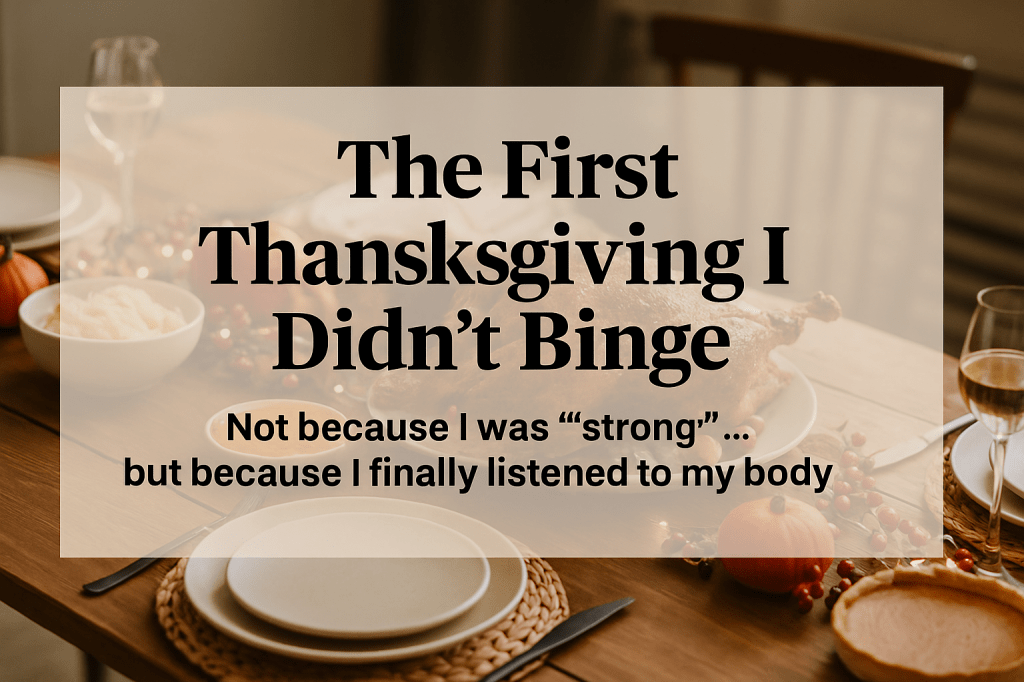
  • How I Made It Through Thanksgiving Without Bingeing for the First Time

    Lately, I’ve been really intentional about stepping away from weight loss as a goal. Not because I don’t want to lose weight eventually… but because I finally understand something huge:

    If I don’t rewire my brain first, any weight I lose will just come right back.

    My brain has been wired since childhood to use food for comfort. Full stop. End of story. And until I address that, I can diet all I want, but nothing will change long-term.

    So right now, I’m focusing on two things:

    Consistency
    and
    Mindful eating.

    These are the two areas I’ve struggled with the most—especially when life gets chaotic.


    Thanksgiving Was the Test… and My Brain Wanted Comfort Food SO Badly

    Thanksgiving break last week was rough in all the ways that usually send me spiraling:

    • Family gatherings
    • Cooking and planning
    • Hosting friends
    • Kids home all day
    • Sensory overload
    • Stress
    • Noise
    • Emotional tension

    And, of course, a big one: my husband and I weren’t getting along.

    In the past, any one of these things would have been enough to push me straight into a binge.

    But this year, I made myself a promise:

    No matter what happens, stay consistent with mindful eating.
    Not perfect. Not restrictive. Just consistent.

    Because here’s the truth:
    Food doesn’t solve any of those problems.
    Not the stress.
    Not the overwhelm.
    Not the noise.
    Not the fighting.
    Not the exhaustion.

    If anything, it makes everything worse because afterward comes the anxiety, the guilt, the bloating, and the crash.


    So This Year, I Did Something Different

    Even through all the chaos, I slowed down.

    I listened to my body.

    I ate when I was hungry.

    I stopped when I was satisfied — not stuffed.

    I even did that at the Thanksgiving meal.
    No seconds.
    No rushing.
    And yes, I had pie.

    But I actually enjoyed the pie. I savored it without guilt, without fear, without using it as a shield to block out my feelings.

    And the most shocking part?

    I didn’t binge even once.

    I truly don’t think that has ever happened to me on a holiday. Maybe not since I was little.


    Rewiring My Brain, One Thought at a Time

    The real work wasn’t the eating — it was the thinking.

    There were moments where my thoughts said:

    “Just eat the leftover pie. It’s in the fridge.”

    Old me would’ve either fought the thought using willpower (and lost)…
    or obeyed it instantly.

    But this time, I watched it.

    I didn’t argue with it.
    I didn’t shame it.
    I didn’t cling to it.
    I just observed:

    Do I actually want pie right now?

    And the answer was an immediate, solid no.

    So I had a coconut bar instead — something that tastes amazing to me, satisfies me, and doesn’t make my blood sugar crash or leave me bloated like pie does.

    It wasn’t about choosing the “healthy” option.
    It was about choosing what I actually wanted.


    I’m Not Focusing on What I Eat — I’m Focusing on How and Why

    This is the foundation I never built before.

    This — the slowing down, the emotional awareness, the consistency, the self-trust — is the work that prevents binges.

    This is the work that heals.

    This is the work that allows the weight to release naturally later, without forcing it, without punishing myself, and without white-knuckling through cravings.

    Right now, I’m not counting calories.
    I’m not restricting.
    I’m not trying to be perfect.
    I’m not chasing a number on a scale.

    I’m fixing the fundamentals I’ve ignored for years.

    Because when my why is in the wrong place, my how will always follow.

    And that’s exactly why the binges happen.

    So this season of my life is about:

    ✨ Choosing consistency over perfection
    ✨ Eating mindfully, not mindlessly
    ✨ Listening to my body, not my stress
    ✨ Rewiring my brain with patience rather than force
    ✨ Being gentle but firm with myself
    ✨ Building trust again, one meal at a time

    And honestly?
    It feels like the first time I’m truly making progress.

  • Breaking the Weekend Binge Cycle: Choosing Consistency Over Cruelty

    Last weekend was Halloween, and I let myself go completely wild. I told myself it was okay — it’s Halloween, after all — and gave myself permission to eat whatever I wanted. That “permission” turned into opening the floodgates, and I ended up gorging myself all weekend long.

    Every night I ate until I felt sick. I couldn’t sleep well, my body was overloaded, and by Monday, I felt physically awful and emotionally wrecked. I even had alcohol on Halloween, which only made things worse — I regretted it the moment I realized how terrible my sleep and anxiety were afterward.

    By Monday morning, I was exhausted, foggy, and anxious. The more I’ve reflected on my past binges, the clearer it’s become: the anxiety always follows. And it’s usually tied to sugar — the more sugar I eat, the more anxious and hopeless I feel in the days after.

    That’s when I made a decision.

    I decided to stop being cruel to myself.
    I decided that I deserve consistency.
    I decided that I deserve a healthy, fit body and a calm, stable mind.

    Because the truth is, gorging myself on food isn’t self-care — it’s self-destruction. And I’m done with that.


    When I Binge, I Disconnect

    When I’m in binge mode, I completely check out. I get irritable, I ignore my kids, I ignore my husband, and I scroll mindlessly on my phone. It’s like I’m not even there. And it can last the entire weekend — once I binge one night, I almost always continue through Sunday.

    Weekdays aren’t the problem anymore; I’ve built better structure during the week. But weekends? My brain still automatically associates them with indulgence and “freedom.” It’s a pattern I’ve repeated so often that it’s now a habit.

    My brain has learned that weekends = sweets, overeating, and escape.
    Now, it’s time to teach it something new.


    Reprogramming My Mind

    This week, I took a gentler approach. Instead of diving into restriction (which only backfires), I allowed myself to binge on fruit if I felt the urge. It’s helping me transition out of the old pattern without the all-or-nothing thinking.

    And moving into the next week, I’m setting small, consistent goals:

    Eat one meal mindfully every day. I struggle with this, especially at dinner when I’m starving and distracted by my kids. I want to practice slowing down, chewing thoroughly, and actually enjoying my food.

    Increase my hydration. I know how much better I feel when I’m drinking enough water.

    Walk at least 6,000 steps a day. Nothing extreme — just enough to move my body and clear my head.


    Each morning, I also spend a few minutes visualizing what it feels like to be at my healthiest weight — strong, confident, and at peace in my body. It’s my reminder that this journey isn’t about punishment; it’s about becoming who I’m meant to be, one small step at a time.


    Why I’m Sharing This

    I’m writing all of this because I know I’m not the only one who struggles. The guilt, the frustration, the feeling of hopelessness — it’s real, and it’s heavy. But I’m ready to change, and I want to help others who feel stuck in the same cycle.

    Because it really does start with mindset.

    My old mindset made me believe I needed to “let go” on weekends to feel free. My new mindset is learning that freedom comes from consistency, not chaos. It’s about teaching my brain that weekends are safe — I don’t need to go into survival mode.

    So this is where my next chapter begins: with small, steady steps toward peace, health, and self-respect.


    If you’re reading this and you relate — you’re not alone.
    This journey is hard, but it’s possible. And we’re worth every effort it takes to heal.

  • Breathwork and Emotional Regulation: Relearning How to Feel Safe in My Body

    I used to think that cravings were my enemy. That if I could just try harder—be more disciplined, more focused, more in control—I wouldn’t end up elbow-deep in the pantry, eating something I didn’t even want.

    But the more I tried to force my way out of sugar cravings, the stronger they seemed to become. And honestly? It made me feel broken. Like I was failing at something that should be simple. “Just don’t eat it,” right?

    But I wasn’t reaching for sugar because I wanted a treat. I was reaching for sugar because something inside of me was screaming for relief. For escape. For safety.

    And sugar, for a long time, felt like the fastest way to quiet the noise.


    The Turning Point

    It took me a while to see that my sugar binges weren’t really about food. They were about regulation. Every time I felt overwhelmed—by the kids, by my own thoughts, by the pressure to do and be everything—I would find myself in the kitchen. Not because I was hungry, but because I didn’t know how else to soothe myself.

    There’s this moment that sticks with me. It was mid-afternoon, both kids were having meltdowns, the house was a mess, and I was running on three hours of sleep. I was standing in front of the pantry, just staring. My heart was pounding. I felt like I couldn’t breathe. And I remember thinking, If I eat something, maybe I’ll feel better.

    And that’s when it clicked. I wasn’t reaching for sugar. I was reaching for peace.


    Enter: Breathwork

    I heard about breathwork years ago, but it always felt too simple. Too slow. I thought it was something people did when they had extra time and soft music playing in the background. Not something you use when your brain is spiraling and your body is begging for comfort.

    But I was wrong.

    I started practicing breathwork during moments that would usually lead to a binge. And not in some elaborate, Instagram-worthy way. I didn’t light candles or sit cross-legged on a meditation pillow. I just… paused.

    I’d put one hand on my chest and one on my belly—so I could actually feel the breath moving through me—and I’d inhale slowly through my nose for four counts. Then I’d exhale through my mouth for six. Sometimes I’d count. Sometimes I wouldn’t. Sometimes I’d cry while I breathed. Sometimes I was just trying not to lose it.

    And honestly? It helped.

    It didn’t make the hard feelings go away. But it gave me a pocket of stillness. A moment to choose what came next, instead of being dragged by an automatic response I didn’t even understand.


    Creating a New Pattern

    The hardest part wasn’t learning how to breathe—it was remembering to breathe.

    Because when you’ve spent years reacting automatically—grabbing food the moment things get hard—your brain is wired for that shortcut. So I had to retrain it. Gently. Repetitively. Without shame.

    And that looked like:

    • Breathing before opening the pantry.
    • Breathing before responding to a stressful text.
    • Breathing when I wanted to escape my own skin.
    • Breathing when my kids were melting down and I could feel myself about to lose it.

    Not always perfectly. Not every time. But enough that it started to feel natural.


    What Breathwork Gave Me

    Breathwork hasn’t made my cravings disappear. But it has changed my relationship with them. Now, when I feel that old pull—the tightness in my chest, the buzzing in my brain, the tunnel vision toward food—I pause. I breathe. I ask myself, What’s really going on here?

    Sometimes the answer is: I’m tired.
    Sometimes it’s: I’m touched out.
    Sometimes it’s: I feel unseen.

    And sometimes, yeah, I still eat the thing. But now it’s not from a place of panic. It’s a conscious decision. That alone is a win.


    Final Thoughts: You Don’t Have to Escape

    If you’re anything like me, sugar may have been your refuge. Your way to soften the world. And I want you to know: You’re not weak. You were doing the best you could with the tools you had. I was too.

    Breathwork gave me a new tool. A way to come back to my body instead of running from it. A way to ride the waves of discomfort instead of drowning in them.

    And it starts with something as small—and as powerful—as one breath.

    You don’t have to escape.
    You can exhale instead.