Last weekend was Halloween, and I let myself go completely wild. I told myself it was okay — it’s Halloween, after all — and gave myself permission to eat whatever I wanted. That “permission” turned into opening the floodgates, and I ended up gorging myself all weekend long.
Every night I ate until I felt sick. I couldn’t sleep well, my body was overloaded, and by Monday, I felt physically awful and emotionally wrecked. I even had alcohol on Halloween, which only made things worse — I regretted it the moment I realized how terrible my sleep and anxiety were afterward.
By Monday morning, I was exhausted, foggy, and anxious. The more I’ve reflected on my past binges, the clearer it’s become: the anxiety always follows. And it’s usually tied to sugar — the more sugar I eat, the more anxious and hopeless I feel in the days after.
That’s when I made a decision.
I decided to stop being cruel to myself.
I decided that I deserve consistency.
I decided that I deserve a healthy, fit body and a calm, stable mind.
Because the truth is, gorging myself on food isn’t self-care — it’s self-destruction. And I’m done with that.
—
When I Binge, I Disconnect
When I’m in binge mode, I completely check out. I get irritable, I ignore my kids, I ignore my husband, and I scroll mindlessly on my phone. It’s like I’m not even there. And it can last the entire weekend — once I binge one night, I almost always continue through Sunday.
Weekdays aren’t the problem anymore; I’ve built better structure during the week. But weekends? My brain still automatically associates them with indulgence and “freedom.” It’s a pattern I’ve repeated so often that it’s now a habit.
My brain has learned that weekends = sweets, overeating, and escape.
Now, it’s time to teach it something new.
—
Reprogramming My Mind
This week, I took a gentler approach. Instead of diving into restriction (which only backfires), I allowed myself to binge on fruit if I felt the urge. It’s helping me transition out of the old pattern without the all-or-nothing thinking.
And moving into the next week, I’m setting small, consistent goals:
Eat one meal mindfully every day. I struggle with this, especially at dinner when I’m starving and distracted by my kids. I want to practice slowing down, chewing thoroughly, and actually enjoying my food.
Increase my hydration. I know how much better I feel when I’m drinking enough water.
Walk at least 6,000 steps a day. Nothing extreme — just enough to move my body and clear my head.
Each morning, I also spend a few minutes visualizing what it feels like to be at my healthiest weight — strong, confident, and at peace in my body. It’s my reminder that this journey isn’t about punishment; it’s about becoming who I’m meant to be, one small step at a time.
—
Why I’m Sharing This
I’m writing all of this because I know I’m not the only one who struggles. The guilt, the frustration, the feeling of hopelessness — it’s real, and it’s heavy. But I’m ready to change, and I want to help others who feel stuck in the same cycle.
Because it really does start with mindset.
My old mindset made me believe I needed to “let go” on weekends to feel free. My new mindset is learning that freedom comes from consistency, not chaos. It’s about teaching my brain that weekends are safe — I don’t need to go into survival mode.
So this is where my next chapter begins: with small, steady steps toward peace, health, and self-respect.
—
If you’re reading this and you relate — you’re not alone.
This journey is hard, but it’s possible. And we’re worth every effort it takes to heal.
Mindful Eating Journey
-
Breaking the Weekend Binge Cycle: Choosing Consistency Over Cruelty
-
Breathwork and Emotional Regulation: Relearning How to Feel Safe in My Body

I used to think that cravings were my enemy. That if I could just try harder—be more disciplined, more focused, more in control—I wouldn’t end up elbow-deep in the pantry, eating something I didn’t even want.
But the more I tried to force my way out of sugar cravings, the stronger they seemed to become. And honestly? It made me feel broken. Like I was failing at something that should be simple. “Just don’t eat it,” right?
But I wasn’t reaching for sugar because I wanted a treat. I was reaching for sugar because something inside of me was screaming for relief. For escape. For safety.
And sugar, for a long time, felt like the fastest way to quiet the noise.
The Turning Point
It took me a while to see that my sugar binges weren’t really about food. They were about regulation. Every time I felt overwhelmed—by the kids, by my own thoughts, by the pressure to do and be everything—I would find myself in the kitchen. Not because I was hungry, but because I didn’t know how else to soothe myself.
There’s this moment that sticks with me. It was mid-afternoon, both kids were having meltdowns, the house was a mess, and I was running on three hours of sleep. I was standing in front of the pantry, just staring. My heart was pounding. I felt like I couldn’t breathe. And I remember thinking, If I eat something, maybe I’ll feel better.
And that’s when it clicked. I wasn’t reaching for sugar. I was reaching for peace.
Enter: Breathwork
I heard about breathwork years ago, but it always felt too simple. Too slow. I thought it was something people did when they had extra time and soft music playing in the background. Not something you use when your brain is spiraling and your body is begging for comfort.
But I was wrong.
I started practicing breathwork during moments that would usually lead to a binge. And not in some elaborate, Instagram-worthy way. I didn’t light candles or sit cross-legged on a meditation pillow. I just… paused.
I’d put one hand on my chest and one on my belly—so I could actually feel the breath moving through me—and I’d inhale slowly through my nose for four counts. Then I’d exhale through my mouth for six. Sometimes I’d count. Sometimes I wouldn’t. Sometimes I’d cry while I breathed. Sometimes I was just trying not to lose it.
And honestly? It helped.
It didn’t make the hard feelings go away. But it gave me a pocket of stillness. A moment to choose what came next, instead of being dragged by an automatic response I didn’t even understand.
Creating a New Pattern
The hardest part wasn’t learning how to breathe—it was remembering to breathe.
Because when you’ve spent years reacting automatically—grabbing food the moment things get hard—your brain is wired for that shortcut. So I had to retrain it. Gently. Repetitively. Without shame.
And that looked like:
- Breathing before opening the pantry.
- Breathing before responding to a stressful text.
- Breathing when I wanted to escape my own skin.
- Breathing when my kids were melting down and I could feel myself about to lose it.
Not always perfectly. Not every time. But enough that it started to feel natural.
What Breathwork Gave Me
Breathwork hasn’t made my cravings disappear. But it has changed my relationship with them. Now, when I feel that old pull—the tightness in my chest, the buzzing in my brain, the tunnel vision toward food—I pause. I breathe. I ask myself, What’s really going on here?
Sometimes the answer is: I’m tired.
Sometimes it’s: I’m touched out.
Sometimes it’s: I feel unseen.And sometimes, yeah, I still eat the thing. But now it’s not from a place of panic. It’s a conscious decision. That alone is a win.
Final Thoughts: You Don’t Have to Escape
If you’re anything like me, sugar may have been your refuge. Your way to soften the world. And I want you to know: You’re not weak. You were doing the best you could with the tools you had. I was too.
Breathwork gave me a new tool. A way to come back to my body instead of running from it. A way to ride the waves of discomfort instead of drowning in them.
And it starts with something as small—and as powerful—as one breath.
You don’t have to escape.
You can exhale instead.
-
Breaking Free from Sugar Addiction: My Story and How You Can Too

Sugar has been my constant companion for as long as I can remember. What started as an innocent treat quickly spiraled into a full-blown addiction, consuming my life, my health, and my happiness. But through years of struggle, heartache, and healing, I’ve found my way out—and I want to share everything I’ve learned with you. Here’s the quick version of my story.

When I was around 17 or 18, still living with my parents, I was obsessed with Twizzlers. They weren’t just candy to me; they were nostalgia—memories of movie nights and camping trips. They gave me comfort, routine, and familiarity during a time of transition between adolescence and adulthood. I would sneak them into my room or nibble on them late at night while watching TV. But one day, something bizarre happened that shifted everything.
I was in the shower when I noticed something red coming from my belly button. Panic set in. I thought I was bleeding. I threw on my bathrobe, ran to my mom, and started freaking out. But then, I dug around and pulled out a red, slimy piece. I sniffed it, and that’s when I laughed—it was a piece of Twizzlers! How it got there? I had no clue. I hadn’t even eaten any for five days. After that, my obsession with Twizzlers lost its appeal a little bit. The absurdity of the moment cracked something open in me: maybe this love affair with candy wasn’t so harmless after all.
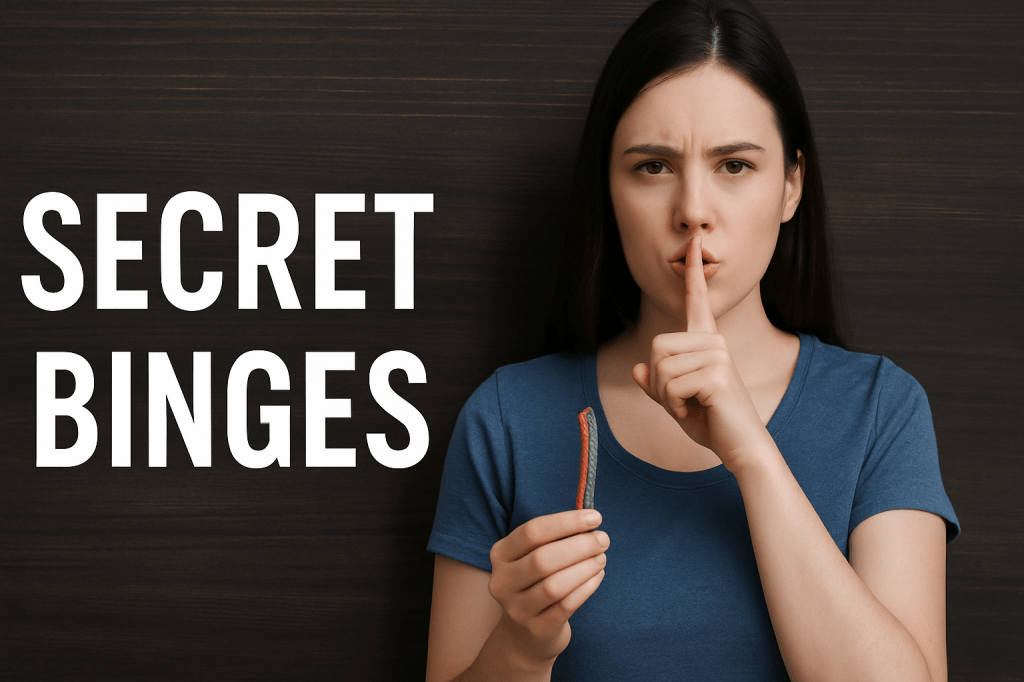
When I moved into an apartment with my soon-to-be husband, my sugar addiction evolved into something more secretive—and more destructive. Sour Punch Bites became my new obsession. I would walk into Target and somehow always find myself in the candy aisle, pretending I was just grabbing a few things. I remember the thrill of ripping open that bag in the car and stuffing handfuls into my mouth. I wasn’t eating for taste—I was eating to escape.
It was a double life. I would buy huge bags, demolish them before my fiancé got home, and then pretend I wasn’t hungry for dinner. I would throw away the evidence and act like everything was fine. Sometimes, I paired it with Chinese takeout, scarfing it all down in a frenzy of emotional eating. The shame would hit hard afterward, but not hard enough to stop me. I was stuck in a vicious loop—eating because I felt depressed, and then feeling more depressed because I was eating and gaining weight.
I began hiding not just the candy, but myself. I avoided mirrors, avoided intimacy, avoided the truth. I knew I was spiraling. At my worst, I weighed 250 lbs, and I didn’t recognize myself anymore. I was afraid of my own reflection—and of what my addiction might eventually cost me.
My health started to scare me. I went to the doctor for bloodwork, fearing diabetes, which ran in my family. I was borderline pre-diabetic. That terrified me. I tried the Paleo diet, and to my shock, it worked. I lost 80 lbs in a year. I thought I had beaten my sugar addiction. But I hadn’t.

By 2017, I was sugar-free for seven months. That was a huge deal for me—seven months without giving in to cravings, without bingeing, without using sugar to numb my feelings. I felt proud, empowered even. So when my sister’s wedding rolled around, I thought I could handle a single indulgence. One brownie. Just one. A reward for how far I had come.
The moment I took a bite, I felt the flood of emotion and nostalgia rush in. The sweetness hit me like a wave—overwhelming and all too familiar. I hadn’t tasted anything that rich in so long, it was like my taste buds lit up and my brain screamed, “MORE!” I didn’t even finish the whole thing, but it was enough to trigger something deep in me. It awakened the addict part of my brain that I thought I had silenced.
Over the next few days, the cravings grew louder. I tried to resist. I reminded myself how good it felt to be free from sugar. But the memory of that brownie lingered like a siren call. I gave in. Then I gave in again. And before long, I was bingeing like I used to—hiding wrappers, sneaking bites, spiraling into shame. That one brownie felt like it undid months of hard work, and I was devastated.

In 2018, I went on a Hawaii cruise, already feeling guilty for regaining weight. I overindulged the entire trip, convincing myself that it was a once-in-a-lifetime experience and I should just enjoy it. But deep down, I was ashamed. I was already disappointed in my body, in my lack of control, and in the role sugar was still playing in my life. Shortly after that trip, I found out I was pregnant with my first child.
At first, I was ecstatic. I wanted to be the best mom, and I imagined having a glowing, healthy pregnancy. But that vision was quickly overtaken by intense cravings and fatigue. Pregnancy amplified everything—my need for comfort, my anxiety, my hormones. I ballooned to 255 lbs. It felt like I had no willpower. I was eating to soothe myself through every emotion: fear, joy, stress, overwhelm.
My dream of a peaceful home birth was shattered when I developed high blood pressure near the end of my pregnancy. I felt like I had failed before I even started. And motherhood? It hit me like a freight train. I tried to breastfeed, work, and survive on almost no sleep. I felt like I was drowning. Sugar became my anchor—even though it was dragging me down. I stashed candy in drawers, snacked during every feeding, and constantly felt like I was just barely holding it together.
I remember crying because I felt like I was missing out on precious moments with my baby. Everything felt like a blur. Instead of soaking in the early days of motherhood, I was lost in a fog of cravings, exhaustion, and guilt. I wanted to be present. I wanted to remember it all. But sugar had such a grip on me that I could barely catch my breath.

Liam was a whirlwind of energy, always moving, never sitting still. Even as a toddler, he was unlike other kids I saw around us—he was climbing furniture, running in circles, and flipping himself into somersaults when others were calmly walking. It wasn’t until we started taking him to social events or out in public that the contrast became painfully clear. While other kids followed instructions or stayed close to their parents, Liam would dart off, touch everything, and completely ignore me when I called his name. I felt judged. I felt like I was doing something wrong as a mom.
The turning point came in 2024 when Liam was diagnosed with severe ADHD. Hearing the words gave me a mix of relief and grief. Relief because finally, there was an explanation. I wasn’t crazy. I wasn’t just a “bad parent.” And grief because I realized just how much Liam had been struggling—how often his needs went misunderstood, even by me.
What made it even more complex was his perfectionism. He wouldn’t try things unless he thought he could master them. He delayed talking, reading, even walking, not because he couldn’t—but because he didn’t want to do it wrong. And then when he did start? He soared. It was like watching a light switch flip on. He went from speaking a few words to full sentences overnight, and later, from not knowing his letter sounds to reading simple books by the end of kindergarten.
Still, the emotional toll was heavy. His unpredictable energy, the defiance, the meltdowns—it drained me. And when I felt drained, I reached for sugar. That became my coping mechanism, my escape, my fuel when I was running on empty. But the guilt was overwhelming. I wanted to be fully present for Liam. I wanted to understand and guide him, not just survive him. But surviving is exactly what I was doing, one day at a time, using food to numb the chaos I didn’t know how to manage.

After everything I went through with my first pregnancy and early motherhood, I knew I wanted things to be different the second time around. I was determined not to fall into the same patterns. I had learned so much—about myself, my triggers, my body, and my emotional limits—and I made a conscious decision to do better for myself and my growing baby.
This time, I stayed active. I stuck to a workout routine, even if it meant just stretching, dancing, or doing a short Barre workout while my toddler played nearby. I still had cravings—because let’s be real, pregnancy does that—but I didn’t let them take over. I was more aware. More intentional. I didn’t want to lose myself again.
My second child, Ashlyn, was born after a much healthier pregnancy. I felt stronger. And while the newborn stage still came with its own chaos, I didn’t spiral into binge eating the way I had before. I held onto the habits I had formed. I gave myself grace but also structure. And that mindset shift made all the difference. I wasn’t perfect, but I was grounded—and that was new for me.—
I decided to take a stand for my health. It wasn’t a single moment of inspiration—it was more like a quiet resolve that built up over time. The chaos of two young kids, work demands, and the constant cycle of sugar highs and crashes had taken their toll. But when Liam started kindergarten, something shifted. With him at school during the day and Ashlyn being more mellow and manageable, I finally had some breathing room.
For the first time in what felt like years, I had space to think. To notice how exhausted and disconnected I felt. I wasn’t just physically tired—I was emotionally drained. My body hurt, my clothes didn’t fit, and my mind was constantly racing with guilt, shame, and the pressure to do better. I realized I had been in survival mode for far too long.
So I started slow. I went for walks. I made meals that didn’t come in wrappers. I danced again. I remembered how it felt to enjoy movement, not use it as punishment. I didn’t overhaul everything overnight, but I began making one mindful choice at a time. I stopped waiting for motivation and just started taking small, loving actions for myself.
Since then, I’ve lost 25 lbs. But more importantly, I’ve found myself again. I’m still on my journey, still learning how to care for my body and mind, but I finally believe I’m worth the effort. That, for me, was the real turning point.

- Mindful Eating: I now take a moment to ask myself if I’m truly hungry before eating. If it’s just a craving, I give myself ten minutes and try to distract myself with something else. Read my full post on how mindful eating helped me break the sugar binge cycle.
- Breathwork and Emotional Regulation: I practice slow, deep breathing whenever I feel overwhelmed. This helps me ground myself and choose how to respond instead of reacting impulsively. Read more about how I use breathwork to pause, regulate, and choose a better response.
- Mindful Presence: I remind myself to be present, especially with my kids. Instead of turning to sugar for comfort, I focus on cherishing those fleeting moments with them.
- Awareness of Triggers: I’ve learned to recognize my triggers—stress, exhaustion, loneliness—and I’m better at catching them before they lead to bingeing.
- Healthier Substitutes: I’ve replaced sugary snacks with healthier options I genuinely enjoy, like fresh fruit, yogurt, or nuts.
- Self-Compassion: When I slip up, I remind myself that I’m human. I don’t spiral into guilt anymore.
If you’re struggling with sugar addiction, please know you’re not alone. It’s not just about willpower—it’s about understanding yourself, your triggers, and finding healthy ways to cope.
 chaosandcarrots.blog